
2026: the Kittiwalkers' report

Updated: 5 days ago
How was 2026 for the endangered kittiwakes in Tromsø? What have the Kittiwalkers done? Here we answer these questions, and a few more!

Léo, one of the most active Kittiwalkers in Tromsø in 2026, surveying the kittiwake hotels in Muséparken.
Highest engagement in 4 years
In 2026, the Kittiwalkers monitored kittiwake nests almost every day from mid March, before eggs were laid, until mid August, after the last chick fledged.
A total of 49 volunteers have contributed through the Rissa Citizen Science app, with varying levels of engagement.
They documented the kittiwakes' breeding success in the city center, in Skattøra and on all the kittiwake hotels.
While out, they spoke with people in the streets and informed about the kittiwakes, kept an eye on illegal destruction and rescued chicks.
The number of submissions (defined here) has been increasing every year since 2023.
Figures 1 and 2: Number of submissions on the Kittiwalker's app, in the city center (above) and at the kittiwake hotels (below) in 2026.
Where were kittiwakes in Tromsø city center in 2026?
The map of apparently occupied nests (defined here) varies throughout the breeding season. The maps below show the apparently occupied nests on 31 July, at the end of the chick-rearing period, before chicks start fledging.
2025: 221 apparently occupied nests, 41 on the kittiwake hotels, 180 on buildings.
2026: 308 apparently occupied nests, 135 on the kittiwake hotels, 173 on buildings. The kittiwake hotels are working!!
Figures 3 and 4: Apparently occupied nests in Tromsø city center (buildings and kittiwake hotels) in 2025 and 2026.
Where were kittiwakes in Skattøra in 2026?
In Skattøra, at the northern end of Tromsø island, the number of apparently occupied nests increased from 64 in 2025 to 109 in 2026 despite measures that make the area less hospitable to kittiwakes.
Cliff 1 (north) has been covered with fine-mesh netting since 2024. This net is effective: 128 apparently occupied nests were recorded in 2024,12 in 2025, and 6 in 2026.
Cliff 2 (middle) had 84 apparently occupied nests in 2024. In 2025 and again in 2026, as kittiwakes were on their eggs, the entire colony was suddenly and mysteriously abandoned overnight.
Figures 5 and 6: Apparently occupied nests in Skattøra in 2025 and 2026.
Cliff 3 (south) had 52 apparently occupied nests in 2025 and 103 in 2026.
Towards the end of the breeding season on 16 August 2025, a man was photographed spraying the cliff with a high-pressure water hose while chicks were still present in their nests. A net was deployed on the cliff shortly afterwards. But the mesh is too wide, the net is also not sealed against the cliff, and as result, birds get trapped in the net ("The net that keeps trapping birds in Skattøra").

A kittiwake is looking at its dead partner caught in the net behind Traasdhal in July 2026.
The Kittiwalkers found 7 gulls trapped in the net behind Traasdhal in 2026:
29. March: 1 herring gull.
1. April: 1 herring gull.
19. April: 1 black-backed gull.
20. April: 1 kittiwake.
22. Mai: 1 kittiwake.
21. Juli: 1 kittiwake.
6. August: 1 kittiwake.
We contacted the landowner in spring and urged them to address the issue. But the net remained, and it kept trapping and killing birds.
The case was subsequently reported to the police, but the net remained in place.
The issue was covered by Nordlys on 21 April 2026, without consequence.
Eventually, Miljøvernforbundet took up the case and contacted both the landowner and Tromsø Municipality in August.
As of today, the net is still on the cliff.
Meanwhile, about 90% of the kittiwakes present a few decades ago in mainland Norway have disappeared, and the species is facing a high risk of extinction (Artsdtabanken, Sandvik et al. 2014)
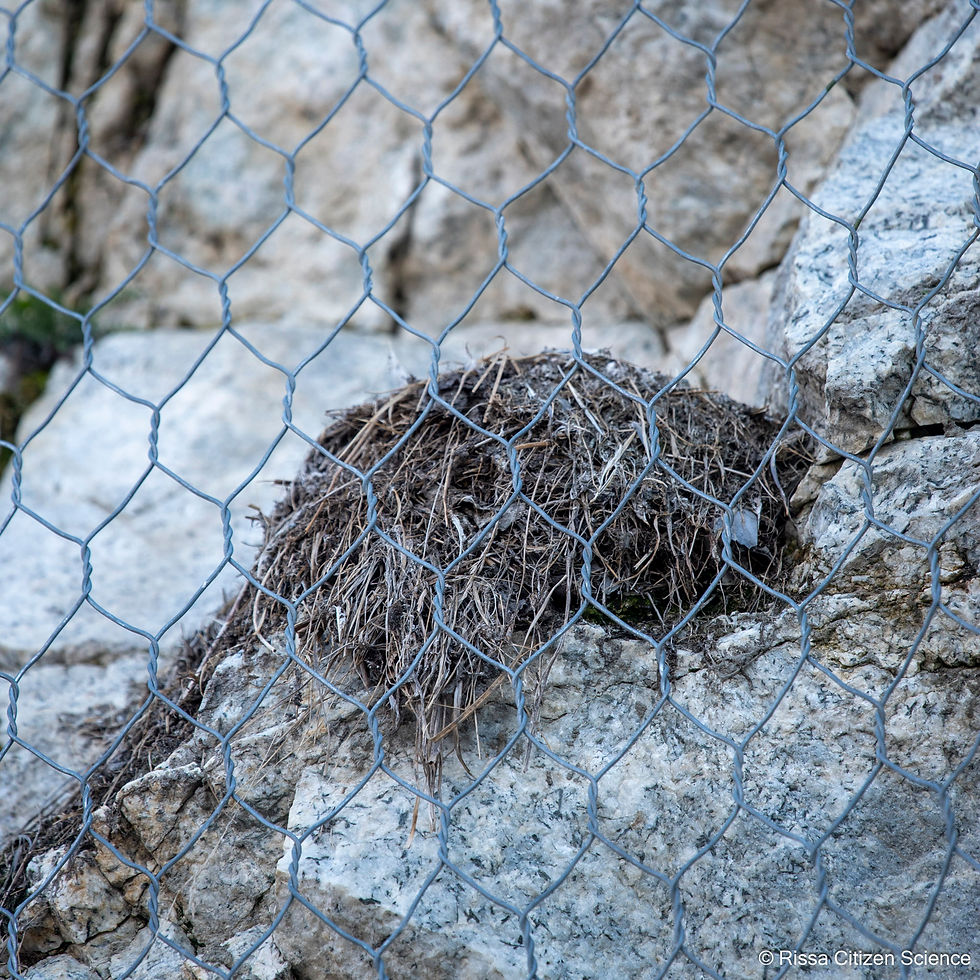
A kittiwake nest behind the net in Skattøra in 2026.
How many kittiwake nests were in Tromsø city center in 2026?
In the city center, at each station (on buildings), the Kittiwalkers counted the number of visible adults (defined here) and the number of apparently occupied nests. The data are compiled in 2-week bins, which are then plotted on the figure below.

Figure 7: Number of visible adults and apparently occupied nests at the stations in the city center in 2026.
The number of visible adults in 2025 and 2026 was significantly higher than in 2023 and 2024.
Between 2025 and 2026, the difference varied throughout the breeding season.
The number of visible adults was higher in 2026 than in 2025 until mid June, but generally lower thereafter. This shift may be linked to nesting sites being fitted with deterrents during the winter of 2025–2026. Many kittiwakes found their previous nesting sites inaccessible when they returned in spring 2026, and eventually abandoned them in search of alternative locations.
In 2026, the number of visible adults peaked at around 600 individuals in mid-July, approximately 100 fewer than the peak of around 700 recorded in mid-June 2025.
According to bird researchers at NINA (Norsk Institutt for Naturforskning), food availability was better in 2026 than in 2025. Yet, the number of apparently occupied nests was lower in 2026, reflecting the continued decline in available nesting sites.

A kittiwake nesting on a building in Tromsø.
How many nests on the kittiwake hotels in Tromsø in 2026?
This is the great news of 2026! Significantly more kittiwakes have been observed nesting on the kittiwake hotels in 2026 than in previous years (Figure 8). This increase reflects both the deployment of new hotels this year and the growing attractiveness of the existing ones.

Figure 8: Use of the kittiwake hotels in Tromsø in 2026.
The peak of apparently occupied nests on the kittiwake hotels was reached in early July, during incubation period, when 222 were recorded in total.
It often takes time for kittiwakes to establish themselves as active breeders at a new site. The first year is often spent claiming a nesting site without laying eggs, before breeding begins in subsequent seasons.
If a kittiwake hotel is well designed and in a good location, its attractiveness is likely to grow year after year. Kittiwakes are highly social birds, and new pairs are more inclined to join an established colony than to nest away from others. It makes the hotels increasingly attractive as their occupancy grows.

Hotel 6 ("Mack Øst") in Tromsø harbor in 2026.
The kittiwake hotels' occupancy
Even though more kittiwakes have used the hotels than ever before, their occupancy is still low, which means they can host many more pairs!

Figure 9: Occupancy rate of the kittiwake hotels in 2025 and 2026. The 31st of July is used here as it is just before the fledging period. The number above the columns indicate the number of apparently occupied nests. Hotels 10, 11 and 12 were deployed in 2026.
Hotel 3 (the green hotel in Muséparken) is by far the most attractive hotel. Over half of the ledges had an apparently occupied nest on 31 July, and nearly 100% of the ledges were claimed by a pair of kittiwake. While non-breeding kittiwakes may breed next year, they contributed to the success of the breeding pairs by strengthening the colony's collective presence and discouraging crows and magpies to land in the middle of the colony to take an egg or a young chick.
Hotels 8 and 9 (Fylkseshuset) have attracted many more kittiwakes this year, partly as a result of the deterrents deployed on the roof of Fylkeshuset that encouraged kittiwakes to move to these hotels.
Kittiwakes also liked the new Hotels 10, 11 and 12 (Strandveien 8): a great start for a first year!
At all the hotels, the occupancy rate has been higher in 2026 compared to 2025. The exception was Hotel 4, but we will get back to it.

Hotel 3, the most successful kittiwake hotel in Tromsø so far.
Predation at the kittiwake hotels
At all the hotels, the number of apparently occupied nests dropped between 15 June (end of the incubating period) and 31 July (end of the chick-rearing period).

Figure 10: Kittiwake hotel occupancy between the incubation and chick-rearing periods (in 2026, the first kittiwake chick in a nest was observed on 22 June (16 June in 2025) and the first fledgling on 2 August (24 july in 2025) although we may have missed earlier chicks). The number above the columns indicate the number of apparently occupied nests.
In 2025, a family of magpies specialized on taking eggs and young chicks on hotels 8 and 9 (Fylkeshuset) and Muséparken (Hotels 3, 4 and 5).
In 2026, the magpies were gone, but a family of crow at Muséparken learned how to take eggs and young chicks on Hotels 3 and 5.
If kittiwake hotels are excellent alternative breeding sites, some of the current designs make kittiwake vulnerable to crows and magpies (we have not observed predation from other species), for example when they have access to the nests from behind. Future kittiwake hotels should take this into consideration in their design and location in an attempt to reduce the risk of predation.
Predation is nevertheless to be expected, as it is a natural part of life in both urban and wild environments. Crows and magpies are also clever and opportunistic predators, and kittiwakes are often poorly equipped to defend their eggs against a determined corvid, no matter how well designed a hotel is.

Clutch size at the kittiwake hotels in 2026
The Kittiwalkers have been documenting the clutch size on Hotel 3 (the green hotel in Muséparken), Hotel 4 (the metal tripod now at Fylkeshuset), Hotel 5 (the mega hotel in Muséparken), and the new Hotels10, 11 and 12 deployed on Strandveien 8.

Figure 11: Clutch size at the kittiwake hotels between 2023 and 2026.
On Hotel 3 and Hotel 5, the number of nests with chicks has increased until 2026: more apparently ocupied nests, and more nests with chicks. Great news for these hotels!
Clutch size varies considerably between hotels, and we have yet to determine what explains these differences.

Kittiwakes and their chicks on Hotel 3 in 2026.
Hotel 4: the exception
Hotel 4 stands out from the other kittiwake hotels, as its attractiveness to kittiwakes declined in both 2025 and again in 2026. Unless the other hotels, the occupancy rate, the number of apparently occupied nests, and the number of nests with at least one chick has been constantly decreasing.
Between 2024 and 2025, Hotel 4 was relocated within Muséparken to a spot close to a tree, which crows and magpies can use as a vantage point. Moreover, nearby trees stand in the way when kittiwakes fly back and to their nests, and they prefer having an open space in front of their nest. For these two reasons, relocating Hotel 4 closer to a tree has probably reduced its attractiveness to kittiwakes.
Then, on 15 March 2026 Hotel 4 was moved over several hundred meters from Muséparken to Fylkeshuset. The few kittiwakes that were breeding on Hotel 4 didn't follow. They may have relocated to nearby Hotel 3 (the green hotel) or Hotel 5 (the mega hotel), potentially contributing to their higher occupancy rates.
Hotel 4 is now standing close to Hotel 8 and Hotel 9 near Fylkeshuset. Let's hope its attractiveness will grow in 2027!

Kjeld Nash, Lawrence Malstaf and the Kittiwalkers are moving Hotel 4 on 15 March 2026.
Are Tromsø's buildings becoming kittiwake free?
In 2025 already, out of the 320 nests mapped in the city center in 2024, the Kittiwalkers reported that 211 nests had been made inaccessible with various bird deterrents during the winter 2024-2025 . That accounted for a 66% loss.
In 2026, out of the 178 nests used by kittiwakes in 2025 in Tromsø city center, 93 have been made inaccessible during the winter 2025-2026 (52% loss).
Kittiwake hotels are effective measures to compensate for the destruction of nesting sites on buildings, and to attract kittiwakes where they are most welcome, which helps reduce conflict.
However, covering buildings with deterrents undermines the principle of coexistence and can intensify conflicts. When an established colony loses access to its nesting sites, the birds often spread to neighbouring buildings, simply shifting the problem elsewhere, to several locations.
As new neighborhoods emerge in Tromsø city center, why not integrate kittiwake nesting sites into urban planning from the start, making coexistence possible rather than pushing the birds into enclaves on the outskirts?

A net was deployed in 2026 over a kittiwke nest on the shopping center Nestranda.
Engaging travelers: an example of regenerative tourism in Tromsø
From 21 March to 25 August, we organized 6 "kittiwalks" for people traveling with Viking Cruises and stopping in Tromsø for a day. In total, 41 travelers joined and monitored the kittiwake nests with an experienced Kittiwalker.
Although the travelers were often unsure what to expect before joining, most rated this experience very high. We focused our attention on the kittiwake hotels, to highlight the solutions found in Tromsø to coexist with kittiwakes.

Travelers monitoring kittiwake nests in Muséparken in July 2026.
These events are very important to us because they demonstrate that a more regenerative form of tourism is possible. Tourism in Tromsø is currently largely nature-based, and follows an extractive model in which nature (a resource freely available to everyone) is turned into profit for a few, frequently at the expense of the very environment on which the industry depends. We want to show that tourism can instead contribute to restoring nature, strengthening local communities, and protecting the natural assets that make Tromsø such an attractive destination.
In this particular case, the activity also helps reshape travellers’ perceptions of gulls, challenging existing prejudices and fostering a more positive attitude towards these misunderstood birds.

Travelers from the USA monitoring kittiwake nests for a few hours during their stop over in Tromsø.
Youth and outreach
In 2026, we organised two guided visits to the kittiwake hotels for school classes. We would love to collaborate more with schools, especially before the summer holiday.
Visit of the kittiwake hotels with a local school in March 2026.
Rescuing kittiwake chicks
In 2026, the Kittiwalkers rescued 14 chicks, 12 of which were raised, ringed and released (2 died after being rescued).
Eleven chicks were found in Skattøra, 2 in Muséparken and 1 near Fylkeshuset. We spent over 13 kg of feed (fish and slurry), over 326 meals from 26 July to 21 August.
We actively used social media to encourage people to stay alert and contact us if they spotted a kittiwake chick on the ground ("Did you find a kittiwake chick on the ground?"). When the last chick was released, we published a short report to keep the participants informed ("The Kittiwalkers rescued 14 kittiwakes chicks in 2026").
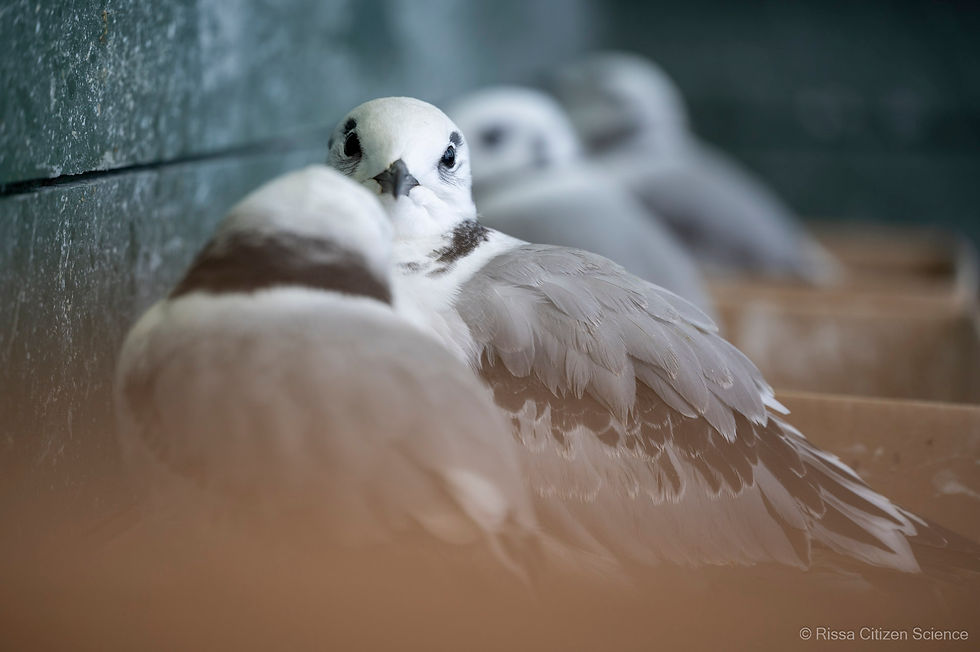
Rescued kittiwake chicks at the Tromsø oprhanage in July.
Adopt a Kittiwake program
In 2026, we launched the adoption program (Adopt a kittiwake and support the conservation of this endangered species in Tromsø).
Eight people joined the program: 2 adopted a nest, and 6 adopted a chick. The chicks stayed at the orphanage, while the foster parents received weekly updates about their nest and chicks. Their donations were used to buy fish, supplementing vitamins and calcium, material to build a shelter and cleaning products.
The foster parents named their chick Big Tex, Boba, Gjøa, Hazel, Hurti, Mischief, Ole, Rinke, Rissa and Tone.

Example of a weekly update received by a foster parent.
Livecam
The rescued chicks were broadcasted live on YouTube from 5 August until 21 August 2026, and everyone could follow the chicks' progress and growth. The kickoff was announced on our various digital platforms ("Watch your rescued kittiwake chicks live!").
This livestream has been a great tool for raising awareness of this endangered species, and keeping a high level of engagement.
What's next?
From now until September 2027, we will continue advocating for better coexistence with the endangered kittiwake in Tromsø, focusing in particular on the following priorities:
Retention of current and recruitement of new Kittiwalkers
Improve the kittiwake chick orphanage
Advocate for a better protection of the kittiwakes in Skattøra
Advocate for the maintain and renovation of Hotel 3 (the green hotel) in Muséparken
Contribute to the local network of stakeholders involved with the urban kittiwakes in Tromsø
Raise funds to cover some of the project's costs
Support Sigurd Vaagland Den Store Måkefilmen project whenever possible
Develop the Adopt A Kittiwake program
Improve the Rissa Citizen Science app for the Kittiwalkers

Rachel, one of Rissa Citizen Science's most valued contributors in 2026!
In Tromsø, several actors are engaged in finding solutions to coexist with the endangered kittiwake. This network include Kjeld Nash who has been playing a key role as a coordinator, Lawrence Malstaf and Kåre Grunnvåg the artists who designed and sometimes built the Kittiwake hotels, Karl-Otto Jacobsen and Tone Reiertsen researchers at NINA/Norsk Instititutt for Naturforskning, Anniken Førde and Bente Sunsvold researchers at UiT-Norges Arktiske Universitet, Helen F. Wilson researcher at Durham university, and Robert Mentzoni Lund and Milena Sontowska at Tromsø kommune.
We want to thank all the volunteers who joined as Kittiwalkers, whether for a single day or every day. Their contribution is priceless. They give their time and energy out of a genuine passion for the cause, without seeking recognition or the spotlight, driven by just one purpose: to help the kittiwake in Tromsø. This year, Julian Nielsen, Léo Tyack-Torrens, Philip Redecker, Rachel Thume and Roel Melman were particularly involved, although 49 people used the app to record their observations and we are immensely grateful to all of them.
In 2026, the Hurtigruten Foundation supported our work with the kittiwakes in Tromsø, and their grant was very appreciated.
Focus Nordic sponsored binoculars, which the Kittiwalkers could borrow.
Definitions:
What is a submission, a station, a unit and a nest ?
In the city center and at Skattøra:
A submission corresponds to an updated observation regarding the number of visible adults and of apparently occupied nests at one given station. An apparently occupied nest is a nest where an adult is lying in a position that suggests that it is incubating or on a chick (or chicks). After hatching, an apparently occupied nest can be a nest with one, two or three chicks, with or without an adult. A station is a location in the city center (typically, a building) used by kittiwakes during the breeding season. A station has at least one active nest at one point during the current year. An active nest is a nest used by a pair of kittiwakes, independently of their breeding success.
At the hotels:
A submission corresponds to updated observations of a given unit regarding the breeding status of every usable ledge (either empty, in use but empty, apparently occupied nest, or with1, 2 or 3 chicks). What is defined as a unit varies between hotels. For example, hotels 3, 4, 8 and 9 each form a whole unit, while hotels 5, 6 and 7 are composed of several units, to facilitate their monitoring by the Kittiwalkers.


Comments