
The Kittiwalkers rescued 14 kittiwakes chicks in 2026

For the third year in a row, Rissa Citizen Science and the Kittiwalkers rescued kittiwake chicks that had fallen from their nests. As in 2025, a live camera was installed at the shelter so that the chicks could be broadcast live on YouTube. We also launched the "Adopt a Kittiwake" program, and we improved our feeding methods and data collection. Here is a short report!

Boba, the youngest chick we rescued this year. It stil had its diamond on its bill when it was found.
But first, why do kittiwake chicks fall off their nest?
Kittiwake chicks instinctively cling to their nest, but accidents happen. When they fall, parents stop taking care of them. Without protection, fallen chicks either get killed by a predator, starve to death or die from hypothermia. Since the species is facing a high risk of extinction in mainland Norway, we decided to intervene, and we rescue all the fallen chicks we can find.
~ 2026 stats ~
14 rescued chicks
12 chicks released (2 died after being rescued)
326 meals
12804 g of feed (fish and slurry)
Location: Skattøra (11 chicks) , Muséparken (2), Fylkeshuset (1).
Team work
Rescuing and caring for kittiwake chicks is truly a team effort. Because Kittiwalkers check the nests every day throughout the chick-rearing period, the chances of spotting a chick that has fallen to the ground are relatively high. Unfortunately, the chances of finding it alive are much lower. Once outside the safety of the nest, a kittiwake chick is highly vulnerable to crows, magpies, herring gulls, cats, rats, ill-intentioned people, and cold and wet weather. Its chances of survival can be very limited without immediate help.

A Kittiwalker is surveying kittiwake hotels 4, 8 and 9 by Fylkshuset.
Last year in 2025, a family of magpies had learned to prey on kittiwake eggs and chicks at Fylkeshuset and Muséparken. This year, the magpies were no longer present, but a family of crows living in Muséparken had learned to steal eggs and young chicks from the two kittiwake hotels.

A hooded crow is harassing a kittiwake on its nest on Hotel 5, in Muséparken (24 June).
We rescued one chick that was severely injured by a predator, covered in blood with a deep cut across its neck. Without intervention, it would likely have survived only a few more minutes. This highlights the importance of checking beneath the nests and in the vegetation around the colonies, every day, and even several times a day.

Léo, Kittiwalker and intern at Rissa CS during monitoring session at Muséparken.
Fourteen people joined the WhatsApp group “Chick Feeders”, and nine took an active part in feeding the chicks, which took place three to five times a day, from 26 July to 21 August. The youngest chicks were also fed during the night, while the older chicks could manage with a late-evening and early-morning meal, and plenty of time to digest in between.
Thumbs up to the feeders!: Barbara, Carsten, Claire, Delphin, Emily, Julian, Lisa, Nathan and Sonja.
Feeding the chicks
In our experience, kittiwake chicks are picky when it comes to food. They seem to dislike fat fish, and prefer the lean ones such as pollock and cod. That is what we gave them, supplemented with vitamins B, D and calcium.
Boba hand fed by Julian.
Some chicks refuse the fish we offer and need to be force-fed. Others arrive at the shelter very skinny and exhausted. Force-feeding can help them regain strength, but it is stressful for the chicks and should therefore only be used temporarily. It helps to place them next to a chick that is already accustomed to taking food from a caretaker, as they can learn by watching the other chick feed.
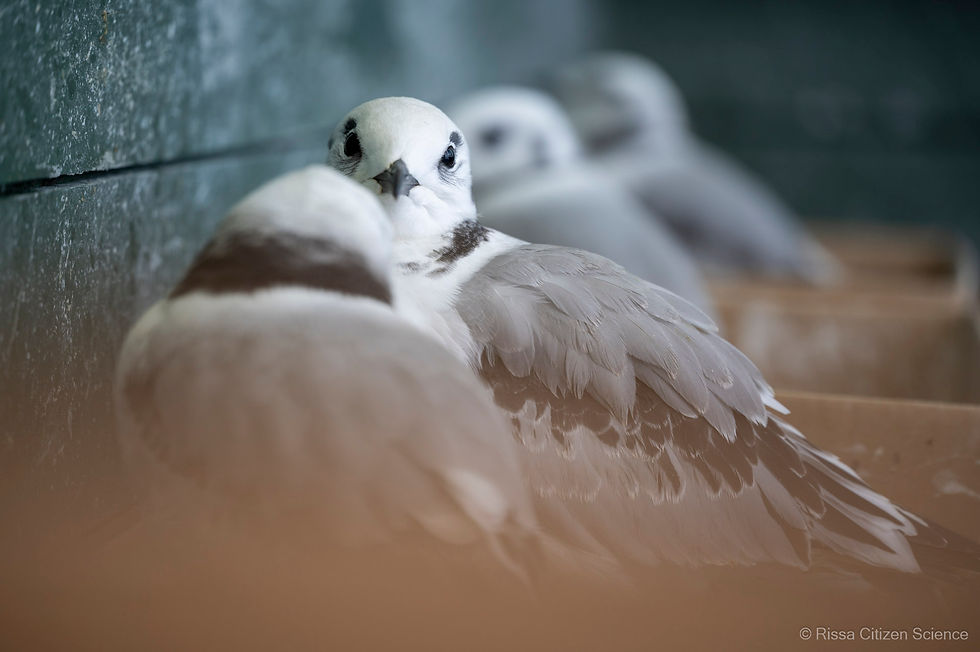
Rescued kittiwake chicks at the orphanage in Tromsø.
When chicks arrive at the shelter, some can only take very small amounts of food, as if their crops have shrunk. For these chicks, we prepare a slurry made from fish fillet, cod liver oil, vitamins, calcium, and water. The slurry is drawn into a syringe fitted with a small tube and gently delivered directly into the crop. With experience, this can be done without even having to hold the chick, making the process less stressful than force-feeding pieces of fish.
This year, out of the 326 meals, 279 were "regular" (chicks taking fish that was presented to them), and 47 were force-fed (27 with fish and 20 with slurry).

Feeding a kittiwke chick with slurry.
Catch and release
Below are the personal records of each chick:
Name, rescue date (mass) - release date (mass) mass gain or loss, number of days in captivity, total amount of food eaten, number of meals.
Chicks were named by the foster parents via the "Adopt a Kittiwake" program.
Personnal records (expand or collapse the list)
Chick #1:
Boba (†)
Chick #2:
Rinke, 26.07 (374 g) - 07.08 (459 g) +85g, 13 days, fed 1837 g, 42 meals.
Chick #3:
Unammed chick (†), 28/07 (138 g) - 04/08 (169 g) +31 g, 8 days, fed 496 g, 23 meals.
Chick #4:
Unammed chick, 29.07 - 01.08 (4 days) +0 g, fed 34 g, 3 meals.
Chick #5:
Tone, 29.07 (372 g) - 08.08 (467 g) +95 g, (10 days), fed 1168 g, 30 meals.
Chick #6:
Hurti, 29.07 (383 g) - 07.08 (376 g) -7 g, 13 days, fed 1218 g, 28 meals.
Chick #7:
Hazel, 31.07 (318 g) - 13.08 (349 g) + 31 g, 14 days, fed 2396 g, 42 meals.
Chick #8:
Big Tex, 03.08 (396 g) - 17-08 (368 g) - 28 g, 15 days, fed 2272 g, 50 meals.
Chick #9:
Unnamed chick, 03-08 (410 g) - 04.08 (410 g) + 0 g, 1 day, fed 3 g, 1 meals.
Chick #10:
Unnamed chick, 03-08 (320 g) - 04.08 (317 g) - 3 g, 2 days, fed 54 g, 2 meals.
Chick #11:
Rissa, 06.08 (392 g) - 15.08 (359 g) - 33 g, 10 days, fed 938 g, 29 meals.
Chick #12:
Ole, 07.08 (382 g) - 15.08 (302 g) - 81 g, 9 days, fed 681 g, 27 meals.
Chick #13:
Gjøa, 07.08 (322 g) - 10.08 (354 g) + 32 g, 4 days, fed 159 g, 8 meals.
Chick #14:
Mischief, 10.08 (294 g) - 21.08 (320 g) +26 g, 11days, fed 1548 g, 41 meals.
A ring for life
We ringed 11 chicks out of the 12 that we released (from 6218851 to 6218861).Once they disperse, most immature kittiwakes do not return to their natal waters until their third summer. We will therefore have to wait until these chicks return to Tromsø, and are caught, to find out whether they have survived and reached adulthood.
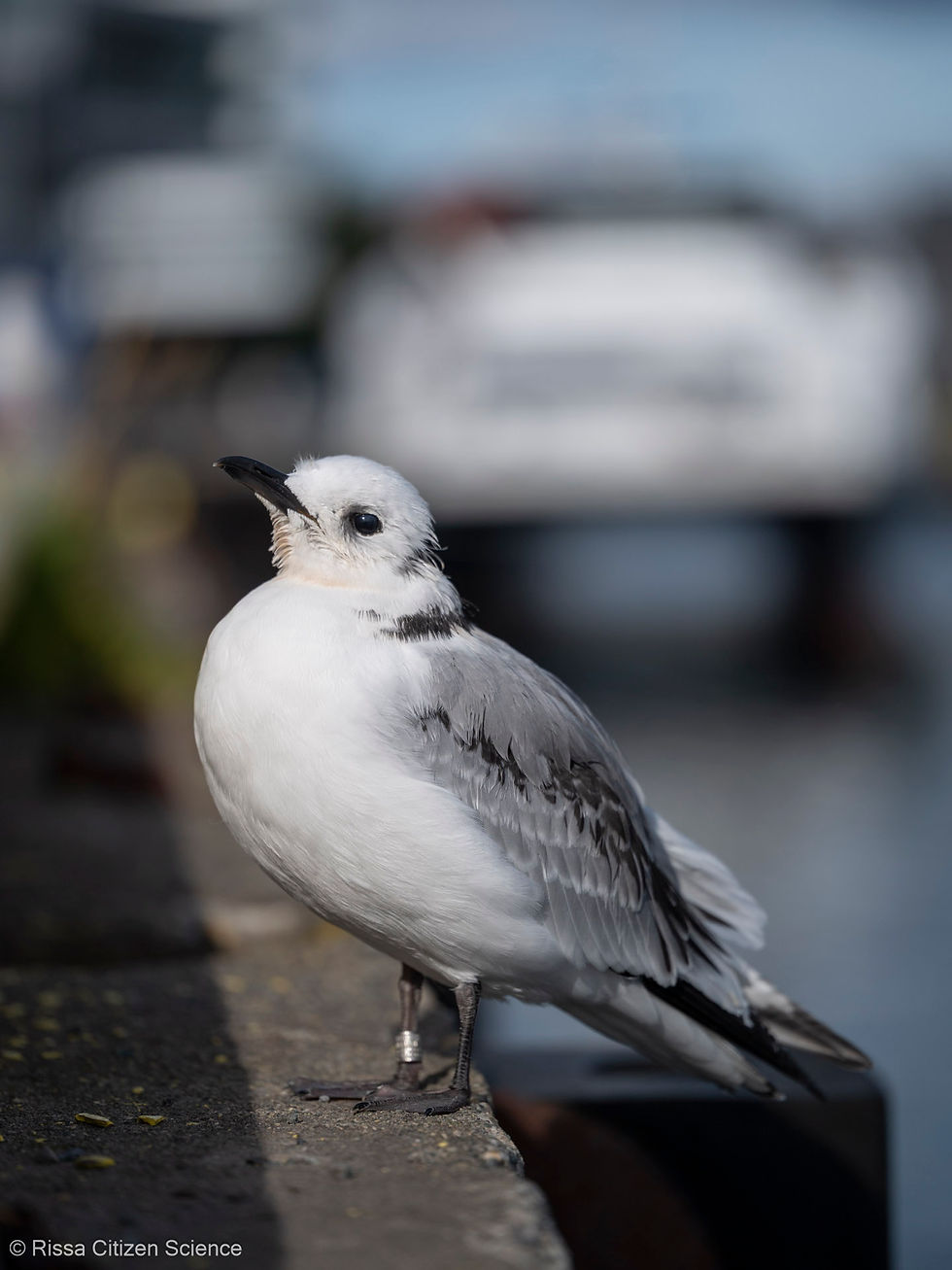
A chick in Tromsø city center after it was rescued, raised, ringed and released.
"Adopt a Kittiwake" program
This year, 8 people joined the "Adopt a Kittiwake" program: 2 adopted a nest, and 6 adopted a chick. The chicks remained at the orphanage, but the foster parents received weekly updates about their nest and chicks. Their donations were used to buy fish, supplementing vitamins and calcium, material to build a shelter and cleaning products.
The foster parents named their chick Big Tex, Boba, Gjøa, Hazel, Hurti, Mischief, Ole, Rinke, Rissa and Tone.
Many thanks to the foster parents Angelina, Anna Klara, David, Megan, Nathan and Trine for their precious support!

Example of a weekly update received by a foster parent.
Live on You Tube!
The rescued chicks were broadcasted live on You Tube from 5 August until 21 August 2026, allowing everyone to follow the chicks' progress and growth. The livestream has been a powerful tool for fostering empathy and raising awareness of this endangered species.
A few seconds of the livestream of the kittiwake chick orphanage in 2026.
Rescuing and looking after kittiwakes would not be possible without the volunteers' various contributions throughout the breeding season. The Kittiwalkers have done a remarkable job again this year. When it comes to rescuing kittiwakes, Julian’s contribution was invaluable: he found 11 of the 14 chicks rescued, all in Skattøra.
The Hurtigruten Foundation is supporting our work with the kittiwakes in Tromsø in 2026.
Focus Nordic has helped us acquire binoculars, which volunteers can borrow to monitor the kittiwake nests during the breeding season.


Comments