
The net that keeps trapping birds in Skattøra.


A black-backed gull trapped in the net behind Traasdhal on 19 April 2026.
Behind Traasdhal, a net was recenlty installed onto a cliff used as a breeding site by several species of seabirds. However, the net is not properly sealed against the cliff and the mesh is too large, resulting in gulls repeatedly becoming trapped.
The Kittiwalkers patrol this site to monitor the kittiwake nests almost every day, and it is during these routine checks that birds are found. So far this year, five birds were found in the deadly net:
29 March: one herring gull.
1 April: one herring gull.
19 April: one black-backed gull.
20 April: one kittiwake.
22 May: one kittiwake.
The Tromsø fire brigade is rescuing a gull trapped in the net behind Traasdhal on 29 March 2026.
Only the fire brigade has access to ladders long enough to reach the birds. Five time, they came and rescued the birds. While some birds have been released, others suffered such severe injuries that they had to be euthanised. The case was reported by Nordlys on 21 April.

According to Miljødirektoratet, nets can be an effective way to prevent gulls from nesting, provided that certain conditions are met. Their website outlines the following requirements:
The net must have a maximum mesh width of 3 cm,
The net requires maintenance to prevent damaged or torn nets from catching birds.
The net installed behind Traasdhal has a mesh size wider than 3 cm, is not properly sealed along the sides, and its curled lower edge creates a deadly trap.
Until the net is removed or replaced with one using a finer mesh, birds will continue becoming entangled. The Kittiwalkers will keep encountering trapped birds and calling the fire brigade to rescue them.

A firefighter is rescuing a bird trapped in the net behind Traasdhal on 1 April 2026.
The black-legged kittiwake is facing exctinction in mainland Norway. It is listed as "endangered" on Norway's Red List.
As stated on Miljødirektoratet's website, "during the breeding season, unnecessary harm and suffering to the birds and their nests is prohibited, as is unnecessary hunting and other disturbance". Yet on 16 August last year, at the same location behind Traasdhal, one of the Kittiwalkers witnessed a man spraying the cliff with a high-pressure hose while chicks were still present in the nests.
A man is spraying water and using a crane at the cliff behind Traasdhal during the breeding season on 16 August 2025.
The nets are allegedly installed for safety reasons, as rocks occasionally break loose from the cliff and fall to the ground. Vehicles parked directly below are at risk of being damaged.
A reasonable compromise would be to leave a buffer zone at the base of the cliff. Even a few metres would be enough to protect both people and parked cars from falling rocks, while also supporting the conservation of the endangered kittiwake and their relative species.
A kittiwake trapped in the nest behind Traasdhal on 20 April 2026.
Seabirds' populations have declined dramatically over the last decades in Norway, and globally. The kittiwake's conservation status is particularly alarming, with a 90% decline over that same period of time. Some of the surviving kittiwakes come to cities to avoid their natural predators.
Coexisting with kittiwakes in Tromsø city centre can present certain challenges when they build nests on buildings. But in Skattøra — an industrial area dominated by car dealerships, metal buildings and warehouses — kittiwakes breed almost exclusively on cliffs.

Kittiwake breeding on the cliff behind Traasdhal in 2025.
Both in Skattøra and in Tromsø city centre, there are ways to reduce the inconveniences associated with kittiwakes, such as noise or smell, while still allowing the birds to remain. By contrast, the continued use of nets, spikes, boards and electric deterrents is not only costly, it is also often ineffective, as displaced birds typically scatter and establish colonies elsewhere.
Restricting access to a nesting site should therefore be combined with the creation of alternative breeding areas, such as kittiwake hotels, located close to former colonies. This approach helps guide birds toward designated nesting locations rather than simply pushing the problem elsewhere.
Rissa Citizen Science is part of a nertwork of competent people in Tromsø who can assist property owners in finding acceptable solutions to coexist with kittiwakes.
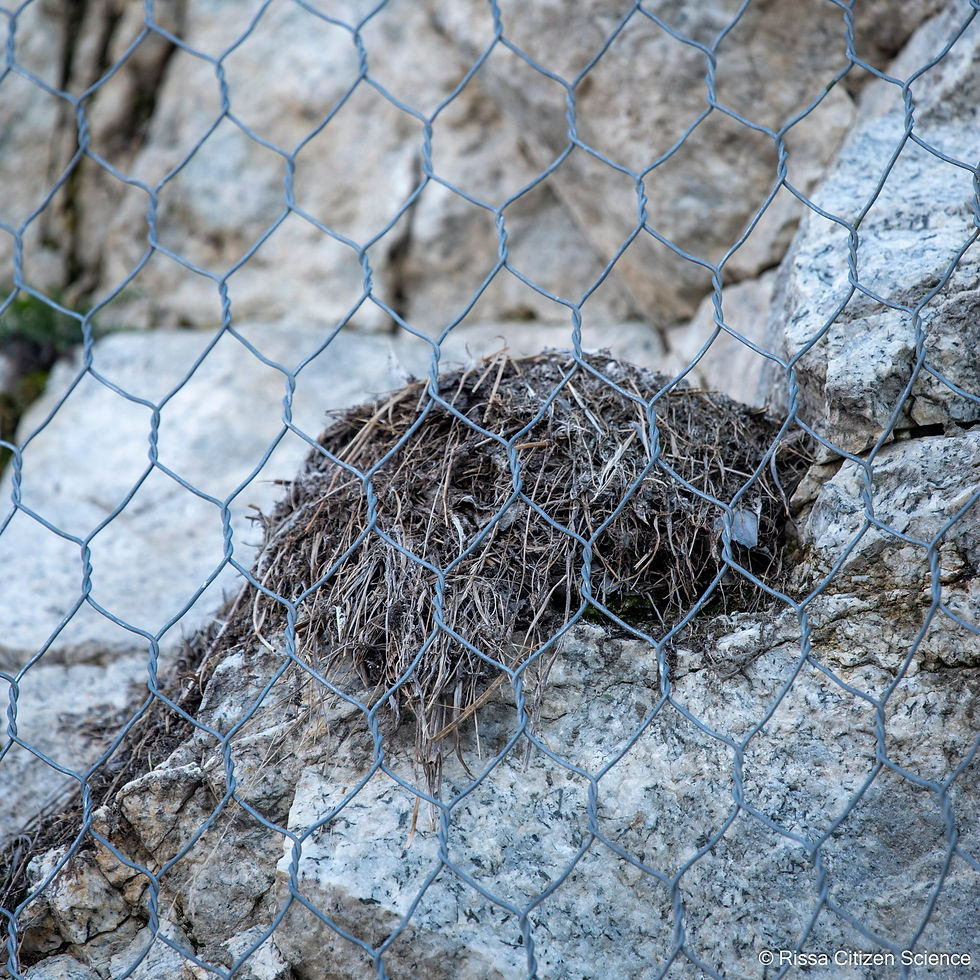
A kittiwake nest on the cliff behind Traasdhal in 2026.


Comments