
A personal story about kelp, waves and waffles.

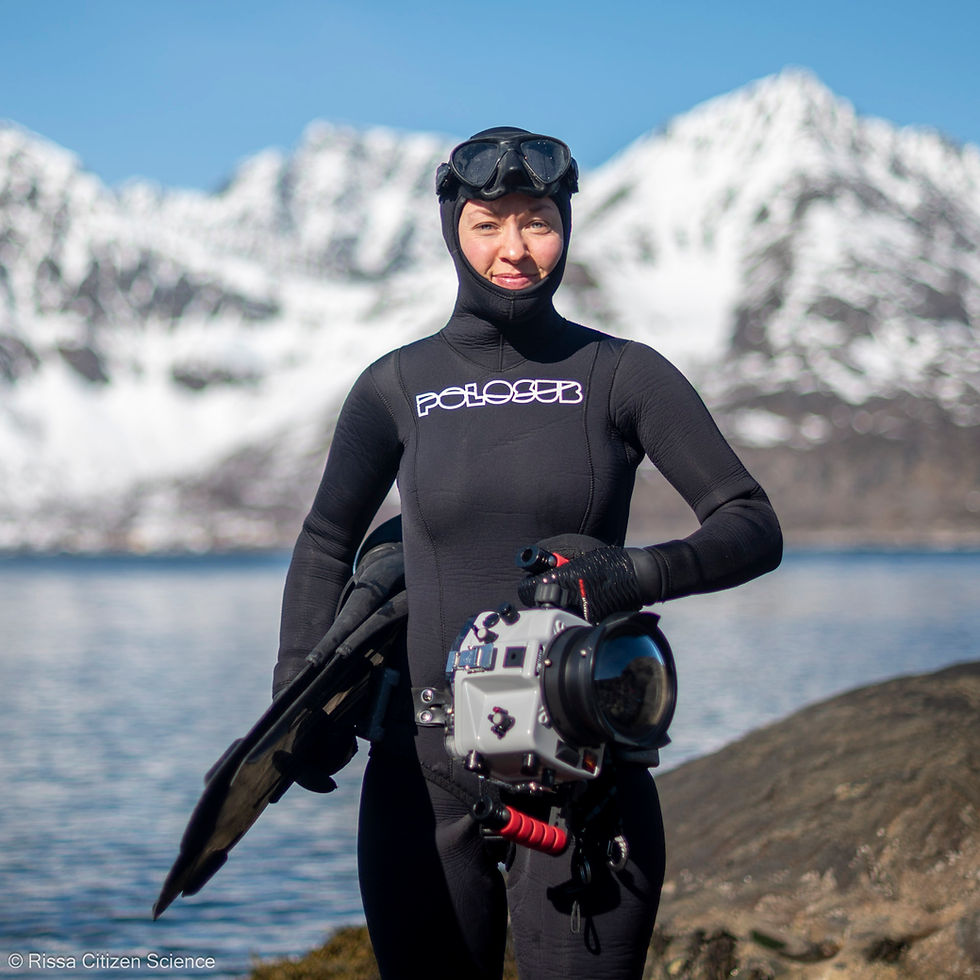
Ann Cools in Øksfjord, Finnmark, May 2026.
A few years ago my relationship with photography started shifting. I used to be obsessed with travel - and I still thrive being out in the world - but deepened insight in the impact of tourism, social media and the western colonial gaze, changed my outlook on visual storytelling.
I’ve always been drawn to connect with the wild world, where the untamed spirit of people, places and moments are my greatest sources of inspiration. And so, my lens turned to nature’s art and impact driven nature conservation. Because showing what works, is essential to inspire positive action.
In April 2025, when I first documented Rissa Citizen Science's kelp restoration project, it felt like I hit the jackpot. A community of local volunteers regularly meets to improve the marine environment of their home town. And the result at the Sørsjetéen jetty in the city center of Tromsø is extraordinary. The once bare rocks are full of colour and life, and kelp grows taller year after year.

Sugar and winged kelp along Sørsjetéen, April 2025.
The contrast with the untouched site in Telegrafbukta couldn’t have been bigger. The pale blue hue of the water made for a desolate seascape, inhabited only by countless sea urchins. Delphin Ruché and I thought that was all there was to it. Until we stumbled upon The Bump: a small patch of seaweed, clinging to a shallow plateau.

The Bump at the Telegrafbukta restoration site. April 2025.
One year later, I return to Telegrafbukta. Under a sky of concrete grey, the bay looks rough and wavy.
Everything is set up for today’s restoration event: a heated tent as changing room for the divers, measuring and safety equipment for the people on land, a waffle maker and hot tea for a cosy wrap-up. Volunteers start trickling in.

Volunteers at the safety briefing, Telegrafbukta. March 2026.
The people who show up for a Rissa Citizen Science restoration event are not a type. There are scientists who speak about ecology with quiet precision. There are residents and long-term expats who feel called to help out. There are people who have never been underwater in their lives and people for whom the sea is a second home. What they share is a willingness to do the patient, unglamorous work of restoring nature. They share the belief that it matters. And perhaps also a soft spot for freshly baked waffles. With chocolate spread dripping out both ends of the rolled up sweetness, spilling all over my hands andthe rolled up sweetness, spilling all over my hands and - oops, I got carried away.
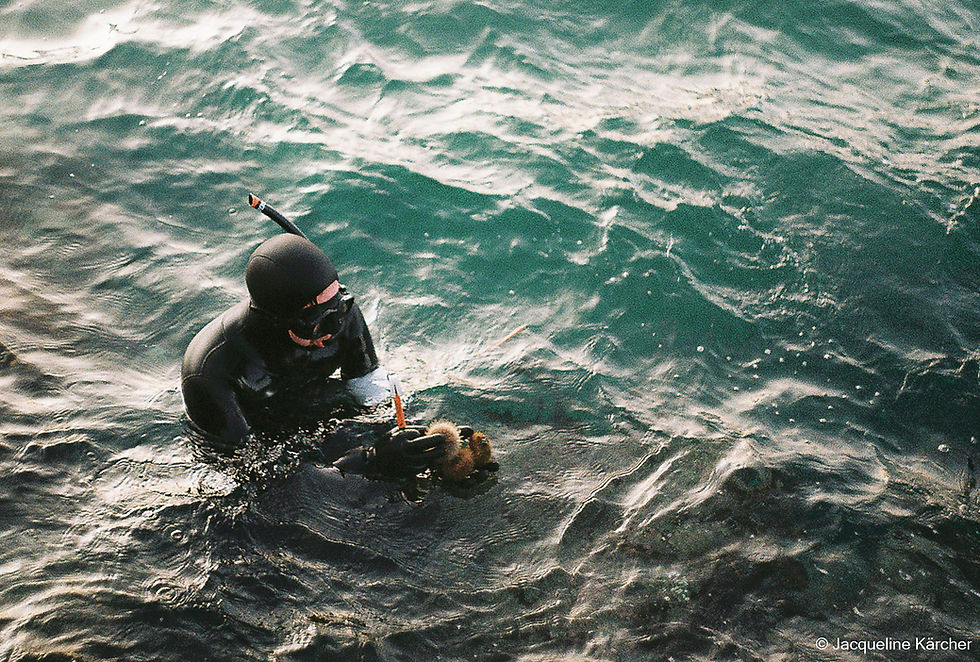
I go in the water. The swell carries me up, then takes me down, closer to the bottom of the bay.

Telegrafbukta, March 2026.
What I see from the surface, is not a transformation. The urchins are still there, but something is shifting. It doesn’t feel quite as empty. I take a deep breath and dive down, unwillingly drifting along the seabed. The pale rock slab looks darker and appears to be covered in green, velvety seaweed. Bright purple and orange starfish catch my eye. I see The Bump is now also hosting snails and anemones.

The increasing shivering of my body indicates I’m reaching my limit for this underwater exploration. On my way to the shore I pass by a captivating hodgepodge of weeds and kelp, wildly swayed by the strong current. A small hermit crab is holding on for dear life.
I can relate to the poor crab as I scramble awkwardly out of the water, taking tiny backward steps with long fins on slippery rocks and gripping my numb hand around the handle of my underwater camera housing. Oh the relief and gratitude I feel for the safety volunteers lending me a hand in that moment.
This is why I keep coming back. Not the before-and-after, recovery doesn't happen overnight. It’s the in-between, the slow middle of the story, where the actual work happens. Where people show up for nature and for each other. And where the waffles are freshly baked.
Ann Cools is a photographer based in Belgium. In recent years, the ocean has become a profound source of inspiration. Her work moves between documentary and poetic reflection, often centred around the intricate bond of humanity and nature.
Visit anncools.com to see more of her work.
Rissa Citizen Science efforts to restore kelp forests with volunteers is supported by the Ocean Green project, which aims at scaling up the restoration of kelp forest in Norway. Ava Ocean leads the project, while the science partners are NIBIO (Norwegian institute for bioeconomy), NIVA (Norwegian institute for water research) and Akvaplan-niva. The commercial partners are Across Nature and Hofseth Biocare. OceanGreen is funded by the Green Platform (Norwegian Research Council and Innovation Norway). 20 Knop helps with dissemination.

Comments