
My First Encounter With the Urchin

Updated: Apr 10
I took the plunge into one of Rissa's kelp restoration events in Tromsø. This is my journey through Arctic marine ecosystems, sea urchin ecology, and multispecies encounters—where an underwater drone, nature conservation, and human perception meet along the Norwegian coast.
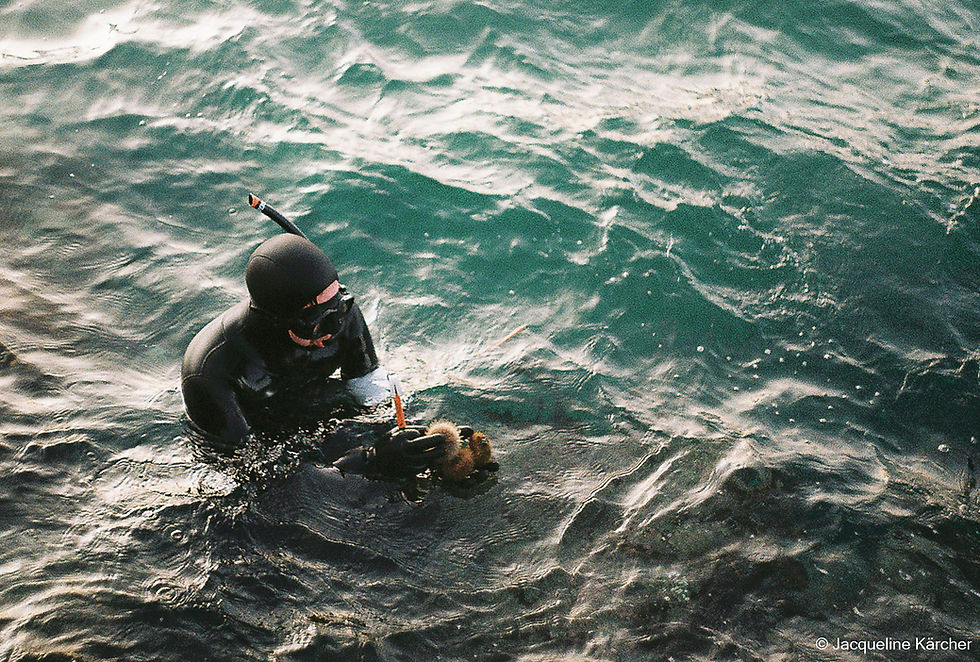
I am a PhD researcher in Tromsø for two weeks of field research browsing in archives, meeting people, tasting the sea, and looking for presence and absence of sea urchins in the Norwegian plate. Until now, I read and asked questions about sea urchins. I wondered, I doubted, I imagined, I talked, I explained. Until now, they grew, they lived, they died, they thrived, they reproduced, they explored, they ate.
The day is grey and colours melt into each other in a soft atmosphere. The yellow of the handrail along the jetty is the only colour standing out and leads me to the cement bunker at the end of the Sørsjetéen. Leaning against the bunker I seek for shelter from the rainy weather and the cold wind.
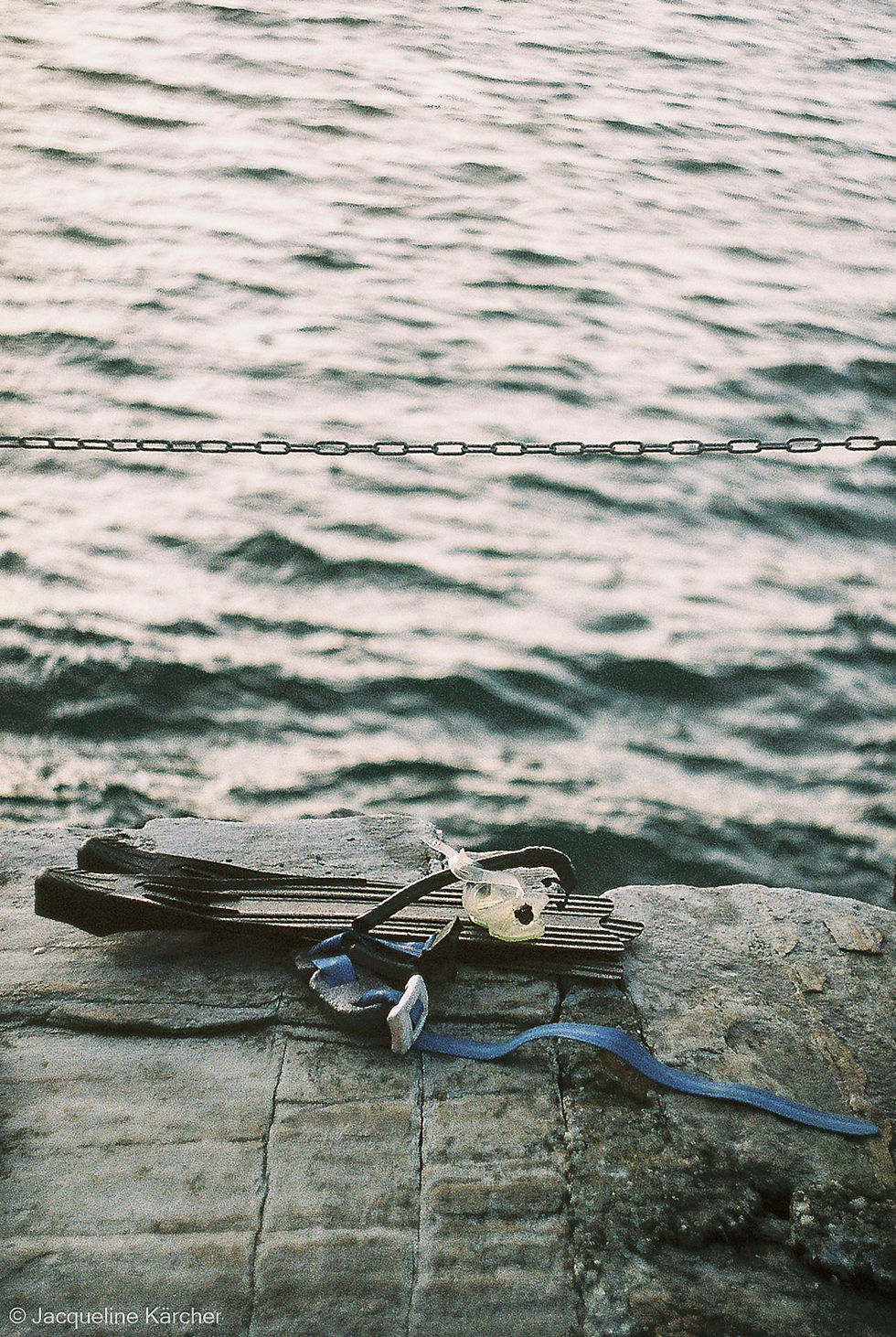
I find myself here under the invitation of marine and conservation biologist Delphin Ruché. I am looking forward to meeting the urchins. Can they distinguish the difference of intents between mine and Delphin’s? That Delphin wants to crush them, while I want to meet them? Would that make a difference in how they move, in how they digest? We live the same spaces, contact zones between wetness and dryness, between in and out. But it’s either you, the urchin breathing underwater, or me, the human, breathing air on dry land. A meeting in the middle is not the solution.
The gloomy day turns the liquid surface into an opaque mirror, an elastic membrane separating the atmosphere from the underwater that only seldom gives up hints of the colours underneath. I cannot perceive much difference between the left and right side of the wharf. One side is supposedly clean from sea urchins, after a restoration project Delphin led last year. While the other side is still covered in spikes, with the aim to show people the striking opposite ecosystems. From the top of the wharf my senses could go as far as the surface. I trust sea urchins are there, I trust that I am in their proximity.
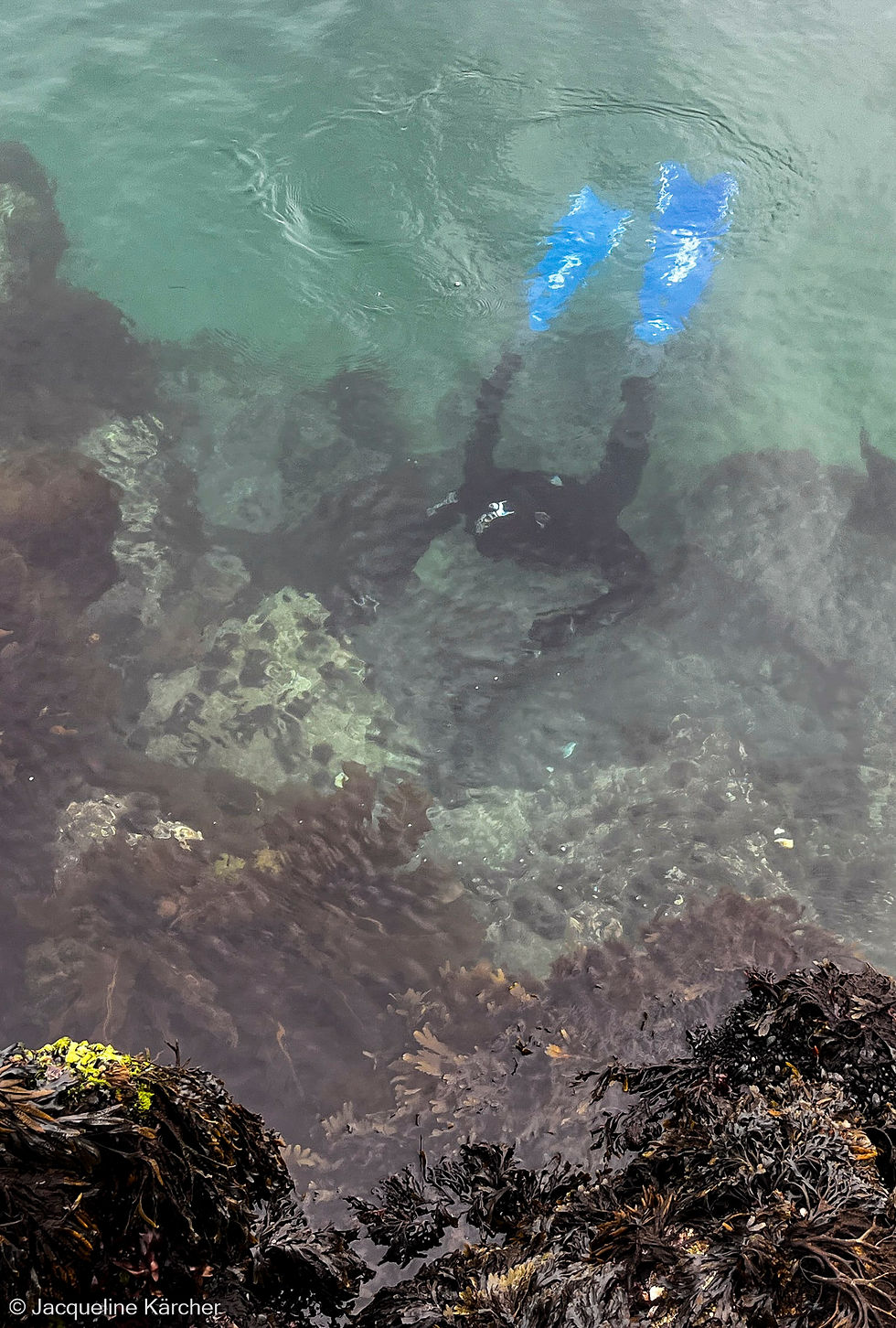
When I stand on the jetty, I am getting closer to them, but there is one complication: the incompatibility of my body and the arctic sea. My skin is not thick enough to tolerate the cold water, my breathing system is not made to inhale the sea and extract the oxygen, and I have not prepared myself with the skills and equipment to dab these lacks.
While Delphin is getting into his wetsuit, I screen around. There is involvement of liquid soap, cold complains, and uncomfortable laughs from the resistance of getting inside the thigh exoskeleton. Tucked in his new thick skin, Delphin organises how to take notes while swimming with a white plastic tube wrapped around his arm and a pencil attached to it.

Sheltered by the outer wall of the cement bunker, which seems to be breathing water through its porous wall, Delphin shows me the treasure inside the heavy box I help carry. A white, long, and sturdy underwater drone comes out. It reminds me of a submarine, but for a very tiny being, and I am about to burrow its eyes to look at life under the surface.
After cautiously breaking the surface of the water without slipping on the algae covering the side of the rocks, Delphin and the drone are now sharing the same space, immersed in a wet environment, which is very different from mine, standing on dry land.
Turn the drone on. Turn on also the Wi-Fi router connecting the drone to the phone functioning as a controller. Turn on the phone-controller. Open the application to control the drone. Lay down the drone in water. Hold the phone horizontally. Select “Start diving.” Use both thumbs to control movement: left, right, forward, backward, up to the surface, down to the seafloor. To control speed, I have two modes on opposite extremes of my speed options: either “snail-speed” or “hare-speed.”


I am dry-diving, encountering underwater multispecies. I think with the Rubber Boots Methods, which emphasized immersive firsthand engagement with ecological sites while I submerge my view to meet this seascape with curious, collaborative, and critical attention to the changing multispecies assemblies living on the sides of the Sørsjetéen (1).
Trust turns into confirmation when I see the urchins through the camera of the drone. Am I more in their proximity now? If I tell the drone to get closer, if the drone gets to touch them, am I also touching them? I am seeing them through a screen. Is it the same encounter one does with a natural documentary? It’s more personal, it’s time-based, it’s fleeting, although it does feel like I am cheating a bit. I am not head-in in the water, swimming with Delphin and the fishes in the harbour.

When do we encounter another species? When do I encounter the urchins? Is it when I arrived in Tromsø? Is it when I walk on the jetty? Is it when I see them on the screen from the camera drone? Is it when I hold, crush, and open one? All these are mode of encounter that allow my various senses to be activated and register every time new, different, and illuminating details of the urchin, me, and my research.
The bucket of urchins in sea water is standing next to me, and I am pondering my next move. Cold salty water is enclosing around my hands. I delicately pick up a green urchin and lay it on the counter of the window. Its spikes move in an alien way. Does it want to go somewhere specific? Does it know that the water is close, just on the other side of the wall? I know I will not see its tube feet because they need water to expand and move. It crawls and I am mesmerized by the movement, by the sea animal crawling in the air. I know my end goal. I just need a slight switch of mind. A jump from contemplating the charming fluid gesture of a breathing animal, to looking at the Echinodermata as a means of food. I don’t think too much about it, while I am taken by the moment. I live in this ambivalent state, two truths simultaneously in my head, staying with the trouble, as Donna Haraway would say (2).

I have my travel spoon with me, but it’s too large to get in, so I end up using my fingers. The fingers that opened the shell, the fingers that cleaned out the offal, the fingers that gently scraped the gonads out of the shell and in my palm. I wash the five orange tongues in salty water. And then, a bit rushing for I don’t know why, the gonads go from my fingertips to my lips, to my tongue, down my digestive track. Salty, fishy, fresh, unfamiliar, surprising. And as fast as I opened it, that fast it was gone.
References cited in this article:
(1) Bubandt et al., “Introduction. Rubber Boots Methods. Outline for a Multispecies Study of the Anthropocene.”
(2) Thom Van Dooren et al., “Multispecies Studies: Cultivating Arts of Attentiveness,” Environmental Humanities 8, no. 1 (2016): 1–23, https://doi.org/10.1215/22011919-3527695.
Aknowledgement
Thanks to Delphin Ruché of Rissa Citizen Science for the kindness and openness, and to Andreas Altenburger for connecting us, and hosting me at the University Museum in Tromsø.
Penelope Volinia is a culinary environmental humanities PhD Researcher at the University of Augsburg, working with “Off the Menu: Appetites, Culture, and Environment” research group, led by Dr. L. Sasha Gora. She focuses on how cuisines
adopt or reject so-called invasive species, and the shifts in human appetites shaping cultural and gastronomic sensibilities. Although she is currently diving deep into the (culinary) Blue Humanities, she sprints from a background that spans between design (BA in Design, IUAV) and ethnobotany (MA in Food Innovation and Management,
UNISG).
To read more about her work in academia, head over to: offthemenu.net


Comments