
A Helping Hand to Senja, part 2: Fjordgård.

Over two eventful days, A Helping Hand brought together local volunteers and visitors in Fjordgård. This time, the focus was on the trail to Hesten, where participants worked together to help protect one of Senja’s most popular hiking areas.

The stairs built by the volunteers of A Helping Hand on the Hesten trail.
Hesten is known for its spectacular views of Segla and attracts large numbers of visitors every year. But heavy foot traffic also leaves its mark. The trail becomes wider, vegetation is worn down, and small tracks gradually develop into alternative paths.
Through A Helping Hand, we wanted to do something about exactly this.
The idea behind the project is simple: visitors to Senja should not only experience its nature, but also have the opportunity to give something back. In Fjordgård, this idea was put into practice through hands-on work on and around the trail to Hesten.
In 2025, Rissa Citizen Science initiated A Helping Hand, in collaboration with the Ånderdalen National Park Board.
In 2026, Senja municipality joined the initiative with the addition of a second site in Fjordgård.

Part of the Fjordgård team during A Helping Hand 2026.
Why Fjordgård?
Fjordgård is a small village on the west coast of Senja. It has fewer than 200 inhabitants but has become one of the most popular destinations in the region, with more than 100,000 visitors in 2025.
After appearing on the front page of National Geographic magazine in 2023, the dramatic mountain Segla has become world-famous.

From the neighbouring mountain Hesten, visitors have a spectacular view of Segla, Fjordgård and the ocean below. The hike to Hesten is now the most popular hike on Senja, and the impact is clearly visible in the landscape. Through A Helping Hand, we wanted to do something about exactly this.
Based on a local initiative
For many years, a small group of passionate locals from the Fjordgård sports club, who call themselves ‘Kloppegruppen’ (the boardwalk group), have organised and maintained the trails on Segla and Hesten on their own initiative. With the immense surge in visitors, this is becoming an increasingly demanding task.
When Rissa Citizen Science and the Ånderdalen National Park Board approached Senja Municipality about a collaboration, Fjordgård was therefore an obvious choice.
With little time before summer, the municipal project team and Fjordgård’s ‘Kloppegruppe’ started planning a pilot version of A Helping Hand Fjordgård.
The aim was to support the local volunteers in their efforts to improve the route to Hesten and assist wherever help was needed.

The start of the Hesten trail durin A Helping Hand 2026.
Wear and tear
Over the course of the two days, we worked on several sections of the trail.
On steep and exposed parts of the mountain, we built simple staircases. Here, the improvements are intended both to reduce wear and tear on the terrain and to improve the safety of those using the trail.
When the terrain becomes difficult, steep, or slippery, hikers naturally tend to move to the sides in search of an easier route. Over time, this causes the trail to widen and puts increasing pressure on the surrounding vegetation.

The heavily eroded Hesten trail in 2026.
The main way to prevent further damage is to channel visitors more effectively, ensuring they stay on the main path rather than widening it further.
Building staircases in the mountains may seem like a major intervention, and it is. But after seeing the extent of the damage on Hesten and how it worsens month by month, it seems like the only effectful solution.

Wear and tear on the Hesten trail during A Helping Hand 2026.
Mission 1: Building staircases
We had 13 international participants joining us in Fjordgård. We divided into groups with four different missions. Team 1 was tasked with helping to build the staircase.
But first, tools, materials, signs and everything else needed for the work had to be carried up the mountain. With heavy backpacks, the group hiked above the tree line, where we set up base camp. Participant Rita even managed to convince passing tourists to help carry heavy poles up the mountain.

Volunteers of A Helping Hand carrying the wood used to protect the Hesten trail.
After some discussion about the exact placement of the staircases on the uneven terrain, Knut-Terje, Kay-Martin, Rino and Hedrunn from ‘Kloppegruppen’ generously shared their skills and experience and guided the participants through the construction. Together with ‘kloppegruppen’ Eleni, Ryan, Luisa, Fiona, Gaia, Juan and Florin, managed to build 40 metres of sturdy wooden stairs in just two days.

Volunteers working together to build stairs on a heavily eroded section of the Hesten trail.
For several of the volunteers, this was a completely new type of work. Some had never used tools like electric saws and drills before. Training and guidance were therefore provided along the way, giving participants the opportunity to learn by doing and from those with more experience.
In the future, the staircases will help keep hikers on the established trail while also providing a safer and more stable surface.

The stairs take shape on the Hesten trail.
Mission 2: Marking the main path
We also worked on trail markings and signage. A clearly marked trail makes it easier for visitors to know where to go, while also helping to protect the surrounding areas.
When the trail to Hesten passes the tree line and reaches the high, open mountain, it starts spreading in all directions. In earlier years, mainly locals hiked this mountain, and because they knew the area well, they needed few signs or trail markings. Today’s visitors do not have the same local knowledge, and the lack of markings leads people to wander off the main path and create new trails.
Satellite images show that in just 10 years, the trail to Hesten has gone from a single narrow, barely visible path to an extensive network of intersecting trails across the mountain.

Aerial photo of the Hesten trail in 2024.
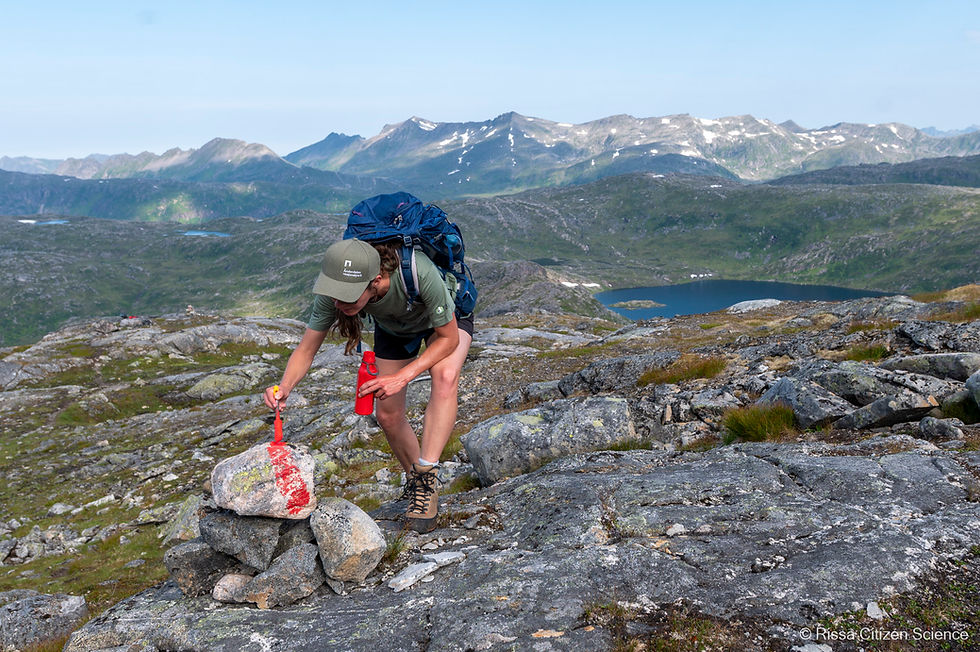
Team 2 was tasked with marking the main path more clearly. The trail markings were also changed from blue along the entire route to blue up to the first viewpoint and red from there to the summit, reflecting the increasing difficulty of the terrain.
Marking a trail is not as simple as it sounds. The markers have to follow an intuitive route and be easily visible to hikers, who often look down while walking. Where the main trail is unclear or splits into several routes, choosing the right location for a marker requires discussion, testing and plenty of walking back and forth.
Vilja and Nora marked the new ‘main route’ to the viewpoint and back, while Gaia, Juan and Marek spent an entire day walking up and down the steepest part of the mountain to identify the safest route among a myriad of alternatives.
The trail-marking team did a tremendous job. Walking down the mountain, covered in paint stains, we could already see how well visitors responded to the clearer markings and how they stayed on the main trail.

Marking the Hesten trail to protect the surrounding tundra.
Mission 3: Closing unnecessary paths
Our third mission was to close unwanted and unnecessary paths.
A single footprint may cause little damage. But when many people choose the same alternative route, the impact quickly becomes visible.
Participants Ruben, Ryan, Nora, Vilja, and Rita used fence posts, ropes, and signs to close off trails so that traffic could be redirected to the main path and the vegetation given time to grow back.
We now rely on visitors to respect the barriers and help us protect the work that has been done.

Closing one of the trails that run parallel to the Hesten trail.
Mission 4: Mapping and documenting damage
Part of the effort also focused on gaining a better overview of the trail network and the surrounding areas: Where are new paths forming? Where is the wear and tear most significant? Where is the main trail becoming wider? And where might further measures be needed?
This mapping provides a better basis for understanding how the area is being used and what should be prioritised in the future work on the trail to Hesten.
We were fortunate to have ecologist Mikel and landscape architect Chenyu join the team as participants. They were tasked with mapping and documenting the vegetation on Hesten and the current damage along and around the trail.
For two days, we saw them walking around completely focused, carrying GPS trackers, taking photos and lying down in the heather to examine the vegetation.
After the workshop, we continued processing their results. Their work will be essential for documenting damage to the vegetation and monitoring whether our efforts have a real impact. Collecting and visualising this data is also key to communicating the effects of mass tourism on our natural environment.
Great food, great people and a real dance party
Saturday (day two) turned out to be an especially memorable one.
The participants who had been working in Ånderdalen National Park joined the volunteer effort in Fjordgård and took part in the work along the trail. Suddenly, a large group of people had come together around a shared task. More than 40 people were hard at work, and the hundreds of tourists passing by that day marvelled at the sight.
Perhaps it is in moments like these that we truly see what A Helping Hand is all about: people coming together, learning from one another, and working side by side to give something back to the place they are visiting. Seeing people work together and laugh in the sunshine, despite language barriers and cultural differences, was a true gift.
After washing off the sweat and dirt from the mountain, everyone involved in the project shared a celebration dinner prepared by local chef Roger Kristiansen.

Celebration dinner with the volunteers.
After two days of working outdoors, it was nice to sit down together, share stories, and get to know each other better.
After dinner, the local volunteer-run pub hosted a party. With half the village joining us, we had a fantastic night.

The Fjordgård rock band setting the pub on fire!
It turns out that Kay-Martin, who had led the staircase construction over the previous days, is also a talented musician and singer. He and his band played party favourites all night, and although our bodies were exhausted, we still had to hit the dance floor.

Ending A Helping Hand on the dance floor.
At around 1 a.m., as the sun began to rise in the north and painted the sky a vibrant pink, we finally gave in to our tiredness and went to sleep.
More than just work
It has become clear to us that the volunteer effort was about much more than the work itself.
Knowledge and experiences were shared along the way, and there was plenty of laughter. People who had never met before worked side by side, helped one another, and found solutions together.
Over the course of the two days, new connections were formed across differences in age, background, and experience. There was room for learning, asking questions, and taking on new challenges, and everyone had something to contribute.
Throughout the workshop, meals were served at the local community centre, which became a natural gathering place between work sessions. Senja Montessori School provided accommodation for the visiting participants.
We were incredibly fortunate to have Lena, Veronica, Unni, Christina, Marit, Liliya, Bror, and Jorunn us with cooking, cleaning and helping during these days. This meant that after a day on the mountain, we could return to a warm meal prepared by a lively and welcoming group of Fjordgård locals.

The kitchen team!
A successful pilot project: visible results and more work awaiting us
After two days of work, we can clearly see the results. Staircases have been built to reduce wear and tear on the terrain and improve safety. Unwanted paths and shortcuts have been closed off, giving nature time to recover. Work has also been done on trail markings and signage, and the trail network and surrounding areas had been mapped to identify where further measures may be needed.
The results are about more than what can be seen on the ground. The participants gained new knowledge and valuable experience. People with different backgrounds and skills worked together, learned from one another, and built new connections along the way. It shows that the value of a project like A Helping Hand cannot be measured simply by the number of staircases built or metres of trail improved.
But the work on Hesten is not finished. There will still be a need for further work and follow-up in the future. At the same time, these two days have shown just how much can be achieved when local people, visiting volunteers, and project partners come together and work towards a shared goal.
Soon the snow will come, and we will take a break from working on Hesten for a while. We will spend the winter planning next year’s work and discussing everything we learned from this year’s A Helping Hand Fjordgård.

The Hesten trail towards Segla in summer 2026.
Finally, we would like to extend a heartfelt thank you to everyone who took part and contributed: the volunteers, local community members, partners, supporters, and everyone who, in different ways, helped make these two days possible.
Thank you for your hard work, enthusiasm, and sense of community.
Together, we are taking care of Senja, one helping hand at a time.
Check out what happened at the other site!:
A Helping Hand to Senja 2026 is collaboration beetween Rissa Citizen Science (lead), Ånderdalen National Park Board , Senja Municipality , Visit Senja Region and Sállir Natur.


It's great to see volunteers from A Helping Hand 2026 are preparing for action on the Hesten trail. Maintaining these natural spaces is such vital work, and I'm sure the upcoming report will be fascinating. It really highlights the diverse challenges people face, whether it's trail maintenance or navigating the complexities of a town of salem. Good luck to everyone involved! 👍