
A Helping Hand to Senja, part 1: Ånderdalen National Park.

Updated: Sep 4
Between 25 July and 2 August, fourteen volunteers joined forces to support Ånderdalen National Park, restoring nature and mapping wildlife. For the 4th year in a row, this initiative is showing that a more regenerative, engaged form of traveling is possible.
This article is about the Ånderdalen site. We will report about the second site, in Fjordgård, in a separate article.

Øystein and Melissa, two of the participants of the 2026 edition of A Helping Hand.
What is A Helping Hand ?
A Helping Hand was born from a simple idea: to give visitors the opportunity to give back to nature in concrete and measurable ways. While outdoor tourism often places pressure on natural environments, A Helping Hand invites participants to become part of the solution, helping restore habitats, address local challenges, and fill important knowledge gaps.
Since 2023, groups of volunteers have gathered in Ånderdalen National Park under the Midnight Sun to take part in hands-on conservation activities that benefit both nature and local communities.

In 2023 and 2024, before founding Rissa Citizen Science, Delphin Ruché organized the first pilot editions of what would later become A Helping Hand in 2025.
In 2025, Rissa Citizen Science initiated A Helping Hand, in collaboration with the Ånderdalen National Park Board.
In 2026, Senja municipality joined the initiative, with the addition of a second site.
Rissa Citizen Science led the initiative, but it was truly a collaborative effort, made possible through a smooth partnership between the Ånderdalen National Park Board, Senja Municipality, Visit Senja Region, and the enthusiastic participation of over15 local residents.

Juan and local volunteers at the Fjordgård site during the 2026 edition of A Helping Hand. More about this second site in a separate article.
The Ånderdalen team: Angus, Anika, Barbara, Daksha, Delphin, Elina, Filippa, Ingve, Kaja, Léo, Luca, Manuel, Markus, Melissa, Ossian, Yulia, and Øystein. With the participation of Anne-Berit, Bente Merethe, Hilde, Ida, Kristin and Lone.

The Ånderdalen team was in the national park in the south of Senja (using 2 campsites), while the Fjordgård team was in the north in Fjordgård (map by Kaja Boudewijn)
Day 1: Getting to know each other, and Ånderdalen
Although most participants were based in Tromsø, others had travelled from different parts of Norway and abroad. Before getting to work, we took the time to acclimatize, discover the landscape, and become familiar with the local weather conditions. Guided by Ingve Birkeland, Manager of Ånderdalen National Park, the group hiked 6 km from Tranøybotn to Åndervatnet, gaining their first introduction to the park they would soon be helping to protect.

Walking through the lowlands of Ånderdalen National Park, between peatland and mixed forests.

Ingve Birkeland spotting a rough-legged buzzard during a break above lake Åndervatnet.

Crossing creeks became part of the daily routine for the Helping Hand team in Ånderdalen.
Mission 1: Looking for the freshwater mussel
Day 2 was dedicated to learning and looking for a threatened species: Margaritifera margaritifera (Elvemusling in Norwegian), whose life cycle depends on healthy rivers used by sea trouts and salmon. Our mission was to investigate the tributary of Ånderelva that passes through Først Velten, and to look for the mussel. But before heading to Først Velten, we visited another creek where freshwater mussel had previously been documented, to see it and learn about it.
We were very fortunate, as freshwater biologist Kristin Johnsen accompanied us, sharing her knowledge and enthusiasm about freshwater ecology.

Field biologist Kristin Johnsen showing a freshwater mussel to the volunteers.
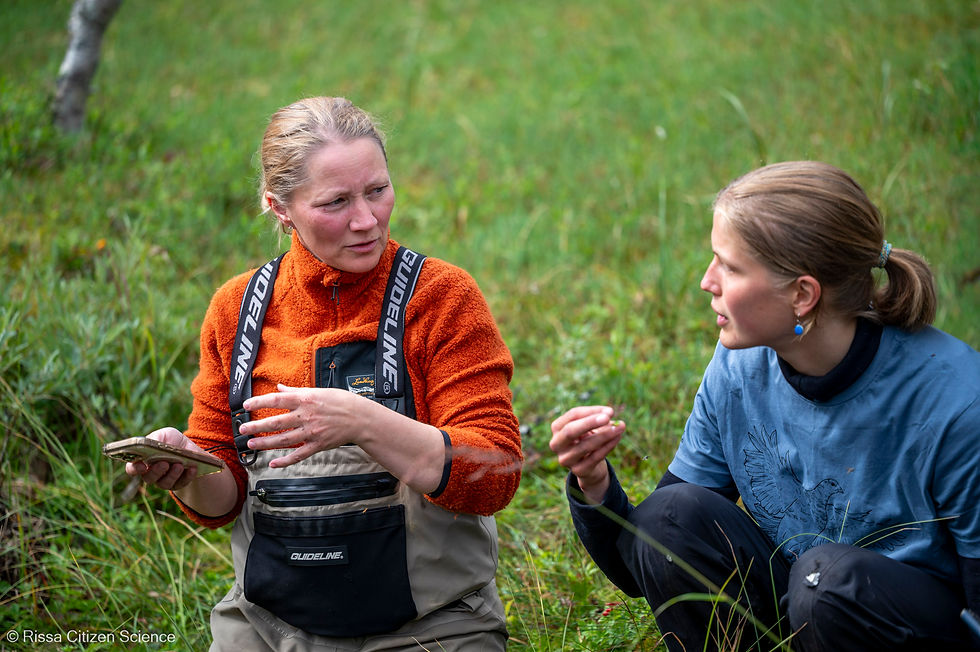
Kristin and Elina having a talk, probably about freshwater mussels.

Field biologist Kristin Johnsen and a freshwater mussel that may be a hundred years old!
After finding freshwater mussels in the first creek, we surveyed the tributary of the Ånderelva, from Først Velten to the main river, a stretch of approximately 500 metres. Although the habitat appeared suitable, with clear water and the presence of juvenile salmonids, we did not find any mussels.
Although everyone was hoping to find mussels in this creek, this result is still valuable for the national park. While it is difficult to prove the complete absence of a species, our survey suggests that it is unlikely this tributary supports a population of freshwater mussels.

Spotting freshwater mussels in the first creek.

Filippa looking for freshwater mussels in the Ånderelva tributary.
Mission 2: building stairs and board walks
On day 3, it was time to step things up with some heavy-duty work! Lone and Ida, two summer employees with the Mountain Service (Fjelltjenesten), met us in the morning for a short briefing before we set off.
Our mission for the following two days was to hike to a steep, heavily eroded section of the trail and build log steps to stabilize the ground, prevent further erosion, and make the trail safer and more accessible for hikers.

Lone, the Fjelltjenesten summer worker who led the construction of the stairs.

Ingve Birkeland, the manager of Ånderdalen National Park, admiring the work of the volunteers.
Lill Eilertsen, project leader for the visitor centre at Sážžás, was part of the stair team. We felt fortunate to have her with us, and took the opportunity to learn more about some of the challenges she faces to develop the national park's visitor center.
While some volunteers focused on building the stairs under Lone's supervision, others followed Ida's guidance and built board walks in flat and wet sections of the trail.

If there's laughter, chances are Anika and Luca are nearby.
By the end of day 4, the work was complete. The new stairs were in place, and sections of waterlogged trails had been fitted with wooden boardwalks. These improvements will help hikers keep their feet dry while allowing the surrounding vegetation to recover.

Part of the stairs team (Angus, Elina, Filippa, Markus missing!).
Meeting Anne-Berit Kristiansen
In the evening of day 3, Anne-Berit Kristiansen, head of the Sør-Senja Reindeer Grazing District, gave a presentation about the Sámi people of Senja. Drawing on both history and her own experiences, she shared insights into Sámi culture, traditions, and contemporary life on the island.
Her talk left a lasting impression on all of us. We are deeply grateful to Anne-Berit for so generously sharing her knowledge and personal stories, and for opening a window into a world that many of us would otherwise never have had the opportunity to hear about.

Anne-Berit Kristiansen sharing her life experiences with the volunteers.
Mission 3: Restoring a peat bog
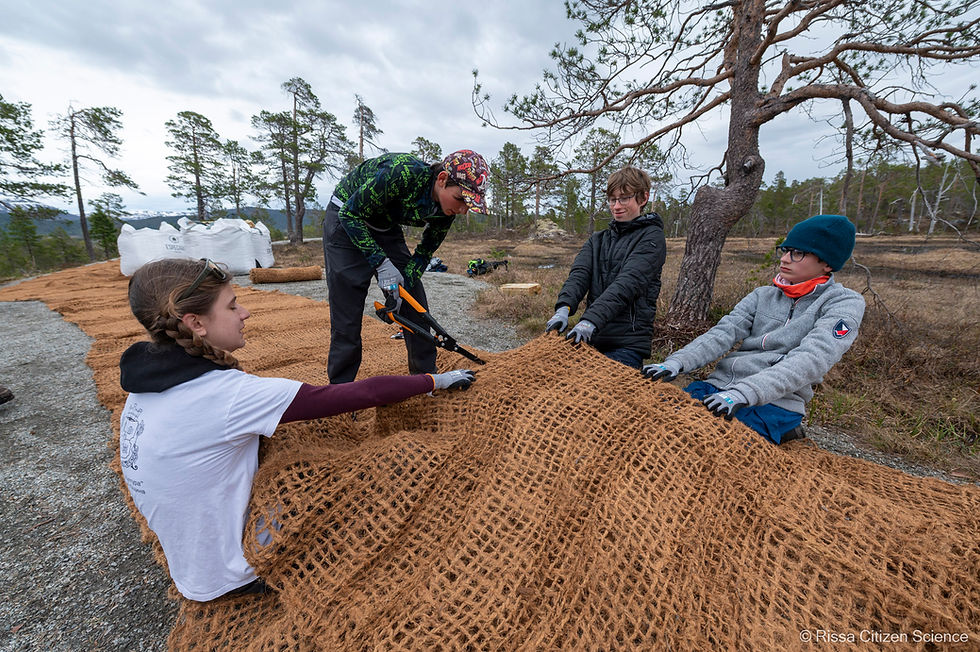
In several places, the trail from Tranøybotn to Åndervatnet cut through fragile peatlands, causing severe erosion. During the 2025 edition of A Helping Hand, volunteers closed the most damaged section of the trail to give nature time to recover. They began restoring this section by slowing water flow and creating conditions for the vegetation to regenerate.
In 2026, under the guidance of Øystein Kristiansen from Sállir Natur, we returned to this section to assess the results of the previous year's restoration work and continue where needed.

Øystein Kristiansen was leading the restoration operations on the closed trail.
To slow the water, we installed biodegradable fibre mats perpendicular to the flow. Healthy peatlands are incredibly valuable: they store large amounts of carbon and act like natural sponges, absorbing water during heavy rainfall and snowmelt before releasing it gradually.

An old footprint is leaving a long-lasting mark in the peat.
Peatlands are extremely susceptible to trampling. A single footprint can leave a permanent scar. As these scars multiply, water begins to channel downhill, accelerating erosion and making the damage increasingly difficult to reverse.

Melissa, world-class fix against erosion and boredom!
Mission 4: Improving the DNT trail in Sør Kaperdalen
In 2025, under the supervision of Bente Merethe Solbjørg, volunteer for DNT (Den Norsk Tursitforening), the Helping Hand team refreshed the markings along the Senja Trail in Sør-Kaperdalen. However, one section running through dense vegetation remained difficult to follow.
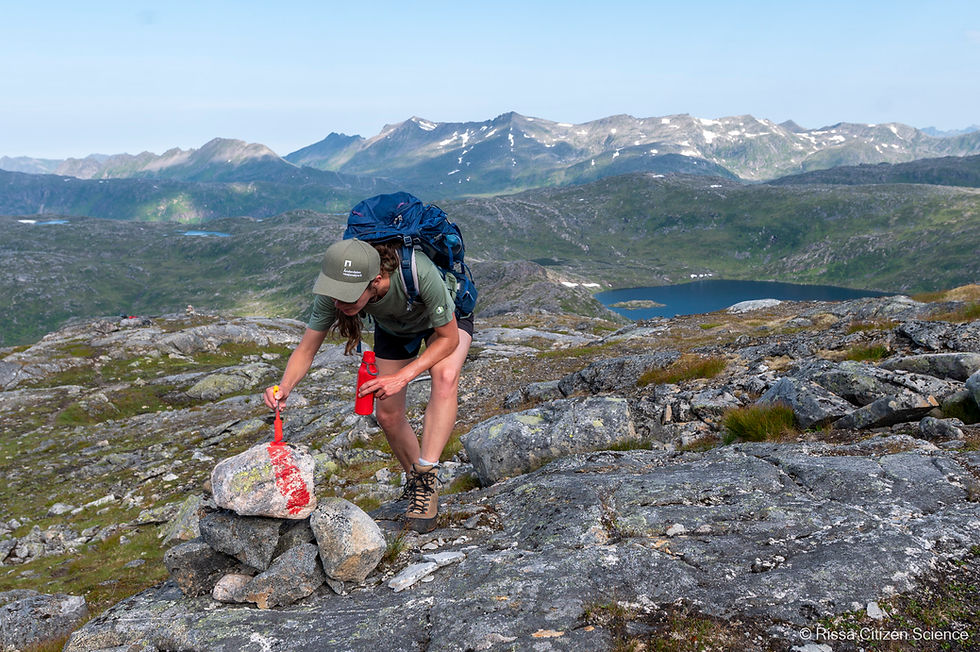
This year, Bente Merethe led us through the national park again, and we cleared some of the vegetation along the trail while adding a few new red markings to make the route easier to follow.

Kaja adding a red mark on a tree to help hikers stay on the Senja trail in Sør Kaperdalen.
The recommended route through this area follows the southern shore of Kapervatnet and Sør-Kaperdalen. The section north of Kapervatnet, towards the unnamed lake in Tverrdalen, should also be avoided, as it crosses fragile peatland.
To encourage hikers to use the southern side of the lake instead, we installed a new sign at the western end of Kapervatnet.

Léo putting up a sign to help hikers follow the trail with the least impact on nature.

The best trail is south of Kapervatnet and in Sør Kaperdalen. To minimize impact on nature, hikers should avoid the northern shore of the lake and Tverrdalen.
Mission 5: Restoring a historical meadow
On the western side of Ånderdalen National Park lies Gjeska meadow (known in Norwegian as slåttemark), a rare and highly valuable nature type in Northern Norway. For generations, people have traditionally cut and removed hay from the meadow. By continuously removing nutrients from the soil, this practice created a unique, species-rich habitat, supporting a remarkable diversity of plants, insects, and fungi, including many species that are rare in Northern Norway.
But farming practices have changed, and the meadow has not been maintained for many years. Without regular cutting, nutrients have accumulated, trees have started to take root, and the forest is gradually reclaiming the meadow.
With scythes and rakes, with guidance from Øystein Kristiansen, we cut the grass and removed the hay from the meadow, helping to restore the conditions that made this habitat so special in the first place. Later this autumn, some of the trees will also be removed.
Melissa, Hilde and Luca using rakes and two types of scythes to restore the Gjeska meadow in Ånderdalen National Park.
Mission 6: Setting up insect traps at the Gjeska meadow
The Gjeska meadow is home to a remarkable and unique diversity of insects. Together with Ingve Birkeland, we set up two types of insect traps: a glass trap and a Malaise trap. Ingve will return in a few days to collect the samples, which will then be sent to specialists all over Europe for identification.
Documenting the presence or rare species, and overall species diversity is essential for demonstrating the ecological value of natural areas and helping guide priorities in future management plans.

Ingve Birkeland and the Malaise trap at the Gjeska meadow.

Manuel setting up a glass trap at the Gjeska meadow.
Mission 7: Mapping flora at the Gjeska meadow
Martin Rennemo from Sállir Natur introduced us to vegetation survey using a 1 × 1 metre quadrat. The volunteers got hands-on experience with the method, carefully estimating the percentage cover of each plant species inside the quadrat and identifying the species growing in the meadow. A simple square became our window into the meadow’s biodiversity, and a way to track how it changes over time!
Martin Rennemo was leading the plant species mapping in Gjeska with the volunteers.
Mission 8: Identifying dragonflies
There is still a knowledge gap when it comes to wildlife in Ånderdalen National Park. Given the time of year and the knowledge available, we decided to focus our efforts on dragonflies, capturing as many as we could, identifying them, and releasing them afterwards. Léo was our dragonfly expert, armed with a butterfly net and the skills needed to give these fierce little hunters their scientific names.

The common blue damselfly had never been registered in Ånderdalen National Park.
Like last year, there seemed to be remarkably few insects in Ånderdalen National Park, barely any mosquitoes, black flies, or horseflies. Maybe as a consequence, very few dragonflies too.
Still, Léo identified four species, including one* that had never been registred in Ånderdalen National Park:
Aeshna caerulea (Hazure hawker, Fjelllibelle)
* Enallagma cyathigerum (Common blue damselfly, Innsjøvannymfe)
Sympetrum danae (Black meadowhawk, Svarthøstlibelle)
Leucorrhinia dubia (White-faced darter, Småtorvlibelle)
Dragonfly and damesfly habitats in Ånderdalen National Park, and the common blue damselfly.
We are very grateful to Artsdatabanken for putting together an amazing identification key for dragonflies (libeller) and damesflies (vannymfer). We recommend it to everyone!
Mission 9: Reducing erosion on the Hesten trail
On day 6 (our last day in the field), we moved to Fjorgård, in the northwest part of Senja, and joined the other team who had been working with a group of locals to close unecessary trails and build stairs on the steepest slopes.
The Hesten trail, with its iconic view of Segla, has become one of Senja’s most popular hiking destinations. In recent years, the local community of Fjordgård has worked extensively to restore and protect the trails around the village, building boardwalks across the most heavily damaged sections. Their hands-on experience has given them a wealth of knowledge and expertise in trail management.
Between the two Helping Hand teams and local volunteers, over 40 people worked together that day on the Hesten trail to protect nature and limit further soil erosion.
If you want to know what the Fjordgård team did while we were in Ånderdalen, check out this article!

Luisa, from the Fjordgård team, showing the restoration site along he Hesten trail to the Ånderdalen team.
Giving back to the volunteers
On our last evening, the hard work gave way to good food, music, and plenty of laughter. Local chef Roger prepared a delicious dinner, served by residents of Fjordgård, before a local band took the stage at the village pub and got everyone in the mood for a proper celebration. Senja Handbryggeriet kept the happy crowd refreshed with locally brewed beers, making for a memorable end to an unforgettable few days. THANK YOU FJORGÅRD!
A Helping Hand to Senja 2026 is collaboration beetween Rissa Citizen Science (lead), Ånderdalen National Park Board , Senja Municipality , Visit Senja Region and Sállir Natur.
A Helping Hand to Senja 2026 was co-financed by Senja kommune, Troms Fylkeskommune , the Ånderdalen National Park Board, and Statskog, with in-kind contributions from Rissa Citizen Science and Sállir Natur.

What an amazing dedication from the volunteers! I found the detailed work on restoring the peat bog particularly fascinating, especially how a single footprint can leave such a lasting mark. It's truly inspiring to see people actively contribute to conservation, making it clear that engaging with nature can be far more rewarding than just sitting back for some unblocked games 66. This kind of regenerative travel is exactly what's needed. 🌱