
Join the Helping Hand project and give back to nature on Senja.

Updated: Aug 12
This year, A Helping Hand expands with the addition of a second site in one of Senja’s most iconic locations. Before you apply to join the project, we invite you to read this short summary.

One of the missions of the 2025 edition of A Helping Hand was to repaint the Senja trail going through Ånderdalen National Park.
What is A Helping Hand ?
A Helping Hand is a project initiated by Rissa Citizen Science, and that started as a collaboration with the Ånderdalen National Park Board. This year, Senja Municipality is taking on a leading role with the addition of a second site around Fjordgård/Segla. Visit Senja Region is supporting the initiative.
Over the past decade, annual visitor numbers on Senja have surged, and this is impacting nature while creating tensions with the local community. A Helping Hand is an opportunity for visitors and residents to join forces, and contribute to the protection of nature, through hands-on restoration and citizen science.
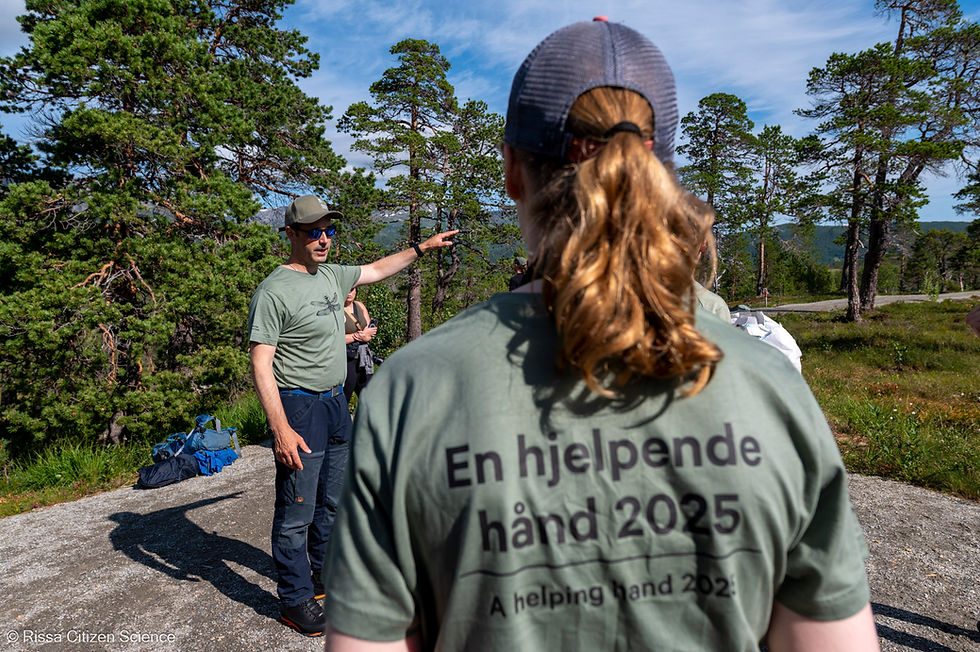
Ingve Birkeland, the manager of Ånderdalen National Park welcoming the participants of A Helping Hand in 2025.
Where and when?
A helping Hand 2026 will take place at two sites simultanously:
Ånderdalen National Park, for 8 days (Saturday 25 July - Sunday 2 August) with 15 participants.
At Fjordgård/Segla, 4 days (Thursday 30 July - Sunday 2 August) with 10 participants.

Segla, one of the most recognizable landmarks on Senja.
How will you contribute?
Tasks may include repairing hiking trails, restoring wetlands, maping trails condition, marking existing trails, building boardwalks, closing damaged trails and creating new ones.
You may also map biodiversity, with a focus on birds, dragonflies, butterflies, and other groups depending on the expertise available. This blog article, A Helping Hand to Ånderdalen National Park: Mission Accomplished!, summarizes what we did during the previous edition.
At both sites, local team leaders will guide the participants, sharing knowledge, and dealing with logistics and safety.
Nature restoration and citizen science: the two sides of A Helping Hand.
What are the differences between the two sites?
The main differences are the duration and the accomodation.
Participants will spent 6 full days in Ånderdalen National Park, and 2 in Fjordgård/Segla.
The tasks will be relativelty similar between the two sites.
The landscape is quite different between the two sites. Feel free to look at the photos on Rissa's blog and on an any ethical search engine.
In Ånderdalen National Park, you will sleep in tent, while in Fjordgård/Segla, you will sleep in the local school. Fjordgård/Segla may offer a more comfortable experience, particularly if it rains that week. On the other hand, the level of immersion in nature is greater in Ånderdalen National Park.

Participant tenting in Ånderdalen National Park during the second pilot in 2024.
How can you join?
The first step is to express your interest on Rissa Citizen Science's events page.
You will be asked to describe your motivation in 100 words (be convincing!)
You will meet with the project leader during a 30-minute call. The purpose of this call is to ensure that you have a clear understanding of what participation involves and that you arrive with the right expectations.
Choose the site, and confirm your participation
Pay the registration fee (NOK 1,500)
Stay in touch with the project leader
Join A Helping Hand !
Share your feedback with us
Note that you can only join one of the two sites.
All the participants will meet on Saturday to share their stories and accomplishments around a delicious meal prepared by a local chef.
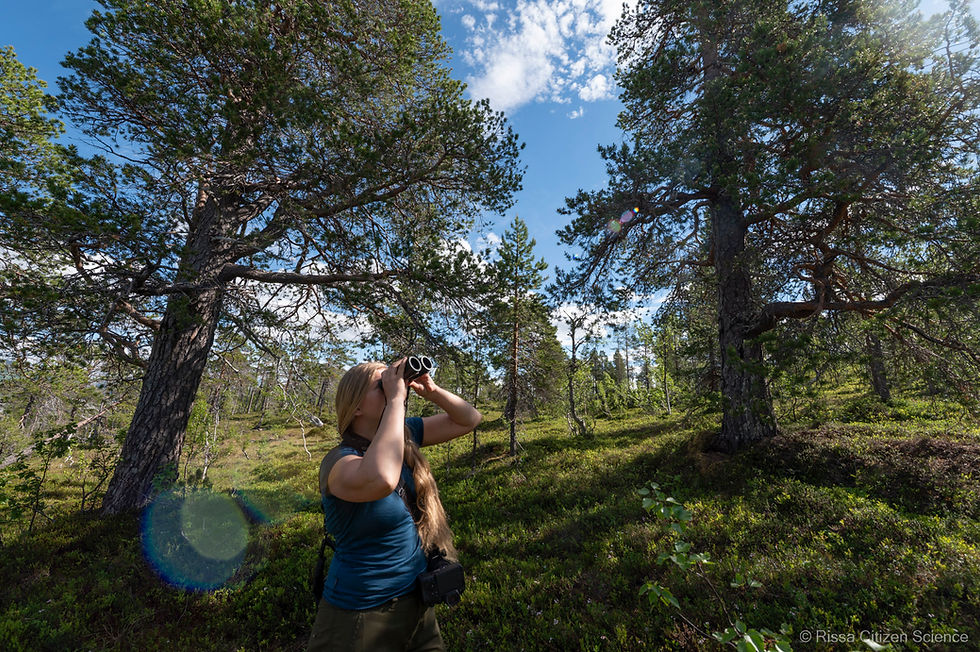
A participant of the pilot in 2024 mapping birds in Ånderdalen National Park.
What are the criteria to join the teams?
The most important criteria for joining A Helping Hand is to be motivated!
There is no age limit, although the participation of those under 18 will require additional precautions.
No previous experience in nature restoration or citizen science is required: we aim to keep the project as inclusive as possible.
The program includes hikes on steep terrain and physically demanding tasks. For that reason, a letter from your GP will be required, but we mostly rely on your common sense and personal judgement to assess whether you are fit to participate in physical activities in the mountain.

Participants of the 2025 edition spreading wooden chips on a hiking trail in Ånderdalen National Park.
Do you need to pay to participate?
The previous edition of A Helping Hand was entirely free of charge, but too many participants cancelled at the last minute. This created logistical challenges and kept other motivated applicants from taking part. We hope that the NOK 1,500 registration fee will be viewed as a commitment and will help reduce last-minute withdrawals.
This fee will help cover some of the costs associated with the project, including food, transport, and equipment. We hope it will not be a barrier to participation, as we want A Helping Hand to remain accessible to all, including students and those with limited financial means.
Participants will receive food, transport, and accommodation from the moment they arrive in Finnsnes on Day 1 until they are transported back to Finnsnes on Sunday, 2 August.
Particiants will also receive gift cards that they can use on Senja before or after A Helping Hand, and good tips about what to do and see in the region at that time of the year.
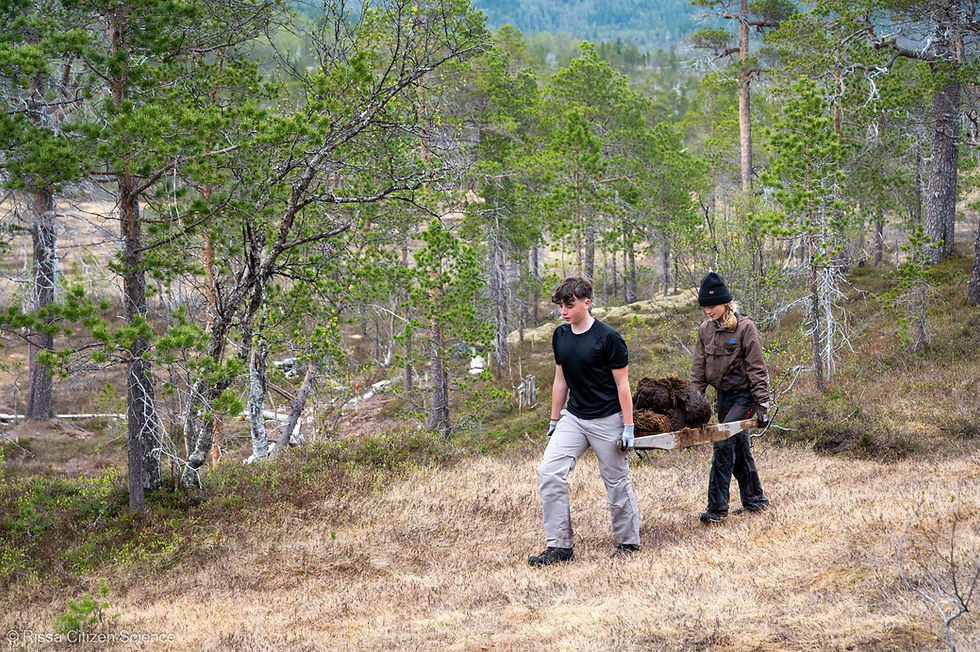
Two participants move peat around to stabilize a hiking trail in Ånderdalen National Park in 2025.
What do you need to bring?
As the saying goes in Norway, Det finnes ikke dårlig vær, bare dårlig klær (there is no bad weather, only bad clothes). Even in summer, the weather can be anything from warm and sunny to cold and wet. Sometimes all the above in the same day. The 2025 edition was dry and warm. Weather conditions were also favourable in 2024 and 2023. But each year is different.
Remember that Senja lies 300 km north of the Arctic Circle. Wool, down and waterproof clothes are always a good pick.
For Ånderdalen National Park, you will need a tent, a sleeping bag, a camping mat and a stove with a cooking pot (we provide the gas canisters).
Recommended items include a knife, a water bottle, binoculars, your favorite snacks, a book or e-reader and sunscreen. Participants will be given a more detailed list of clothes and equipment beforehand.

A participant remarking the Senja trail during the 2025 edition. At this altitude, even in summer, temperatures often drop below zero.
Should you be afraid of insects?
Anyone who has hiked or camped in the Arctic during summer knows that insects can be a bit overwhelming. Mosquitoes, black flies, no-see-ums (Culicoides), and deer flies make for a diverse community of biting insects at these high latitudes.
Conditions vary considerably from year to year: last summer was dry and warm, allowing for sleeveless clothing most of the time, while other years, or certain areas, can be more challenging. In most cases, non-toxic insect repellent combined with a good mosquito head net and long sleeves is sufficient to make do of the situation.

Sundews (or droseras) are very common on Senja. Unlike most humans, these carnivorous plants love insects.
More about the two sites:
Ånderdalen National Park represents the variation in the beautiful northern Norwegian coastal landscape. There is a big difference between the coast and the "inner part" of the national park. The coast is characterized by pointed peaks, sharp edges and steep mountain sides. The inner part has rounded shapes and a flatter and softer landscape.
Visitor numbers in Ånderdalen National Park have risen from about 2,000 in 2010 to nearly 20,000 in 2024. This surge poses a major challenge: how can the park provide quality visitor experience while protecting its landscapes and wildlife, especially with limited staff and funding?
The small town of Fjordgård made its way to the world map after National Geographic in 2022 brought a photo of the area on its front page. The photo is of the majestic and breathtaking mountain Segla, taken from the nearby mountain Hesten.

Since then, the number of visitors has spiked. Fjordgård is a small town and the increasing interest in the place is showing, both on the roads and in the mountains, where more and more vegetation is damaged.
A Helping Hand to Senja 2026 is collaboration beetween Rissa Citizen Science, Ånderdalen National Park Board , Senja Municipality and Visit Senja Region.
We are able to finance A Helping Hand to Senja 2026 thanks to the support of Troms Fylkeskommune and Statskog.


It's truly insightful how A Helping Hand addresses the challenge of increased visitor numbers on Senja by bringing together locals and tourists for hands-on conservation. The detail about the NOK 1,500 registration fee to ensure commitment makes perfect sense, preventing last-minute cancellations and fostering a deeper connection to the project. This initiative really exemplifies how community involvement can turn visitors into active stewards of nature, much like how engaging sz games can foster a sense of purpose and learning.