
What made the Tromsø kittiwake hotels attractive in 2025?

Designing, building and installing kittiwake hotels takes dedication and resources, so understanding what truly draws the birds to them is key. The observations collected by the Kittiwalkers during the 2025 season offer important clues. In this short article, Giulia Castellani presents her findings based on an analysis of the Kittiwalkers’ data.

Giulia Castellani enjoying the Norwegian Arctic.
Hi! I am Giulia Castellani. I am a sea-ice scientist and I wrote a Post-Master’s Degree project about Sustainable Development and Climate Change at the University of Pisa, Italy. In this short article, I am sharing the main findings regarding the kittiwakes hotels and their utilization in Tromsø, hoping my modest contribution will be useful to those who are designing hotels, or deciding their location.
During the year I lived and worked in Tromsø, I directly experienced the challenges posed by the co-existence with seabirds in an urban environment. This sparked my curiosity and motivation to study the utilization of the hotels by the kittiwakes.
This work is important to me because it addresses the growing need of sharing our living space with others, whether with animals or human beings. Learning to share our cities with the kittiwakes is a small but crucial step in developing the mindset required for a harmonious coexistence as imposed by current environmental and societal changes.
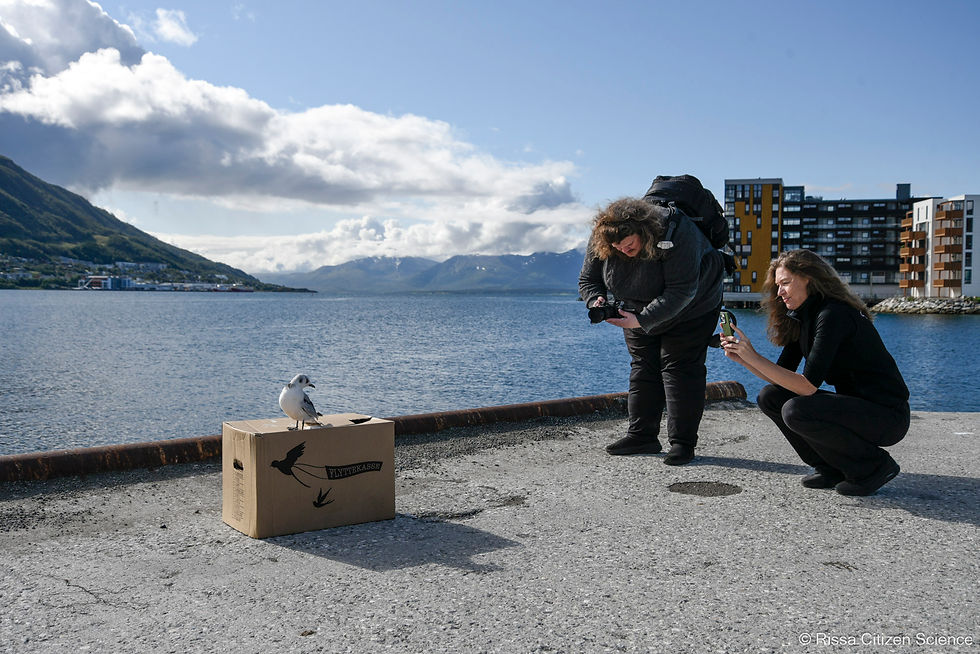
A rescued kittiwake chick released by two Kittiwalkers in Tromsø in 2025.
What are the best hotels in Tromsø?
In 2025, the Kittiwalkers monitored seven kittiwake hotels. All of them were used to some extent, but occupancy varied considerably. Here, the occupancy rate is defined as the number of apparently occupied nests (a nest with an adult incubating an egg, or containing at least one chick) over the number of nesting spots available.

Hotels 3, 5 and 4 (from left to right) at Muséparken in summer 2025.
At the peak of the breeding season, the most successful hotel was Hotel 3. It reached an occupancy rate of 60%. The remaining hotels all stayed below 50% (Figure 1).

Figure 1: Occupancy rate of kittiwake hotels 3 to 7 during the 2025 nesting season in Tromsø.
This is encouraging: it means the existing hotels have the capacity to accommodate more of the kittiwakes displaced from nearby buildings. This is good news, considering that previous nests on buildings get destroyed every winter, and kittiwakes look for new sites in spring. But the relatively low occupancy rates may also suggest that some hotels have not been that attractive to kittiwakes. Understanding what drives these differences in attractiveness was precisely the focus of my thesis.
Lows and highs of Hotel 5
Hotel 5 was installed in 2025. This colorful structure is the result of a collaboration between two creative minds: architect Kjeld Nash from AT Arkitektur and visual artist Lawrence Malstaf. Both are based in Tromsø and are strong advocates for the kittiwake.
Commissioned by Robert Menzoni Lund from Tromsø municipality, Hotel 5 is now the largest kittiwake hotel in the city. This tripod structure features 460 nesting ledges distributed across three floors.

Hotel 5 in May 2025.
Most kittiwakes chose to nest on the top floor. The middle floor had a lower occupancy, and the lower floor was not used at all (Figure 2). “Better high up than one floor down” could have been the kittiwakes' motto!

Figure 2: Number of Apparently Occupied Nests (AON) at Hotel 5 during the 2025 nesting season in Tromsø.
We can only speculate about the reasons behind this distribution. Greater height likely provides a stronger sense of safety. Although kittiwakes tolerate human presence, otherwise they would not nest in cities, they still seem to prefer some distance from people, as well as from dogs, cats, and bicycles.

A Kittiwalker monitoring Hotel 5 in may 2025.
Accessibility to the ledges may also have played a role, as the upper ledges are easier to approach and depart from in flight. A row of birch trees nearby may represent an obstacle, making access to the lower levels more demanding and potentially discouraging use.
Kittiwalkers in Muséparken in summer 2025.
It is also important to remember that this was Hotel 5’s first year, so a rather low occupancy was expected. Since conspecific attraction comes into play, more displaced kittiwakes may be drawn to the pairs already breeding there, gradually filling Hotel 5 from the top down.
A view to the sea or the city?
Hotels 6 and 7 had one side facing the sea, the other facing the city. Their occupancy was irregular, and they were eventually totally abandoned due to their proximity with people (we told the story in this article).
.

A Kittiwalker counting kittiwake nests on Hotels 6 and 7 in June 2025.
After Hotels 6 and 7 were finally protected from disturbance by an improvised fence on 25 May, kittiwakes used the sea-facing side almost exclusively (Figure 3). This comes as little surprise since kittiwakes arrive from the sea and are constantly flying back and forth to their nests.

Figure 3: Number of Apparently Occupied Nests on Hotels 6 and 7 in 2025

Kittiwakes on the sea-side of Hotels 6 and 7 in June 2025.
Observations from Hotel 5 (high vs low) further suggest that the relatively low height of Hotels 6 and 7 may not have worked in their favor, especially when the first fence was removed and people started walking by and under the hotels. The disturbance increased, leading kittiwakes to abandon the site.

Hotel 6 deserted by kittiwakes due to disturbance following the removal of the fence at the start of the nesting neason.
What was Tromsø 5-star hotel in 2025?
The data collected by the Kittiwalkers show that the hotel of the year 2025 was Hotel 3.

Hotel 3: the most attractive kittiwake hotel in Tromsø.
There are certainly several reasons why Hotel 3 was the most attractive. I will venture to suggest a few, some speculative, others supported by data.
Let's begin with a hypothetical explanation, one that is often proposed by people contemplating the hotels: kittiwakes favored Hotel 3 because it resembles a cliff, the kittiwakes' original nesting habitat. The problem with this argument is that some of the buildings that attract kittiwakes in the city center bear little resemblance to cliffs at all. Kittiwakes might find the design of Hotel 3 attractive for some reason, but there might be others factors explaining its success.

Hotel 3 at Muséparken in July 2024.
An important factor to consider is that Hotel 3 was installed in early 2023 and had already been used by kittiwakes for two breeding seasons by the time the 2025 season began. Since kittiwakes tend to find safety in numbers, the attractiveness of a colony is likely to increase over time, provided that new breeding birds continue to search for nesting sites.
In this sense, older hotels (with more nests) may become more appealing than brand new hotels. Kittiwakes also show site fidelity, often returning to the same colony, if not the exact same nest. Although in some cases kittiwakes might adopt a new hotel immediately, it will often take time for the birds to colonize a new nesting site, and it will take a longer time for the hotel to be fully booked. One key lesson is the importance of establishing permanent nesting sites, allowing time for their attractiveness to increase.

Hotel 4 close to a tree, in May 2025.
Located next to Hotel 3 was Hotel 4, which was moved closer to a tree before the 2025 breeding season. The kittiwakes did not respond positively to this relocation. A comparison of the 2024 and 2025 data reveals a sharp decline in the number of nests, along with a significant drop in the number of chicks. This decline and this drop were not as sharp on Hotel 3, which was only a few meters away.

Figure 4 : Number of chicks born at Hotel 4 in 2024 and 2025.

Figure 5 : Number of chicks born at Hotel 3 in 2024 and 2025.
The proximity to the tree was detrimental, but why was it so?
Here again, we can only speculate. Kittiwakes may prefer a wide, open space in front of their nests because they are constantly flying to and from them and it is easier to do so when no tree is standing in the way.
Nesting near a tree, where crows and magpie can perch, could also increase the kittiwakes' vulnerability to predators and elevate stress levels.
Kittiwake chicks are easy prey for the smart and opportunistic hooded crows and magpies.
Here is a non exhaustive list of what might help design and deploy a successful kittiwake hotel:
Relatively high, to provide a feeling of safety in a busy city,
Permanent, to let its attractiveness grow over time,
With a wide-open space in front of the nests, to facilitate the manoeuvres in flight and reduce predation (and the stress associated with the presence of crows and magpies perching nearby),
Facing the sea side, since that is where kittiwakes fly from and return about a billion times a day!
And enough distance to pedestrians, to minimise disturbance.
In 2025, Sparebankstiftelsen SpareBank 1 Nord-Norge and Birdlife Troms have supported Rissa Citizen Science’s work with kittiwakes in Tromsø. In 2026, the Hurtigruten Foundation is supporting this long-term effort. Rissa Citizen Science is able to lend binoculars to the Kittiwalkers thanks to a generous support from Focus Nordic. We are using the Kite Ursus 10x42 and are very happy with them.


Comments