
Tromsø's kittiwake hotels are filling up: the mid-season update

Updated: Jul 3
As most breeding kittiwakes are still incubating (the first chick was spotted on 21/6), kittiwake hotels have reached their peak occupancy. This update is made possible thanks to the commitment of the Kittiwalkers, who monitor the nests in Tromsø and submit their observations through the Rissa Citizen Science app.

The seaside of Hotel 6 near Mack Øst, 26 June 2026.
The Kittiwalkers
The monitoring effort keeps increasing year after year, as a result of a growing interest for the conservation of the kittiwake in Tromsø.

Figure 1: Kittiwalkers' engagement at the kittiwake hotels. The full line for 2026 shows the number of submissions until 15 June. For the kittiwake hotels, a submission consists of all observations recorded by a Kittiwalker during a survey of a particular hotel and entered into the Rissa Citizen Science app. An "apparently occupied nest"(AON) is a nest that is believed to contain at least one egg or chick. In most cases, this assessment is based on the behaviour of the adult bird. For example, when an adult is observed sitting low on its stomach on a ledge containing nesting material, the nest is generally considered occupied, even if the eggs or chicks themselves are not visible.
About 50 contributors have helped build the database since its creation in December 2024, each participating in a way that suits their availability and routines. These trained volunteers monitoring kittiwake nests in Tromsø are doing a remarkable job and deserve recognition for their efforts.
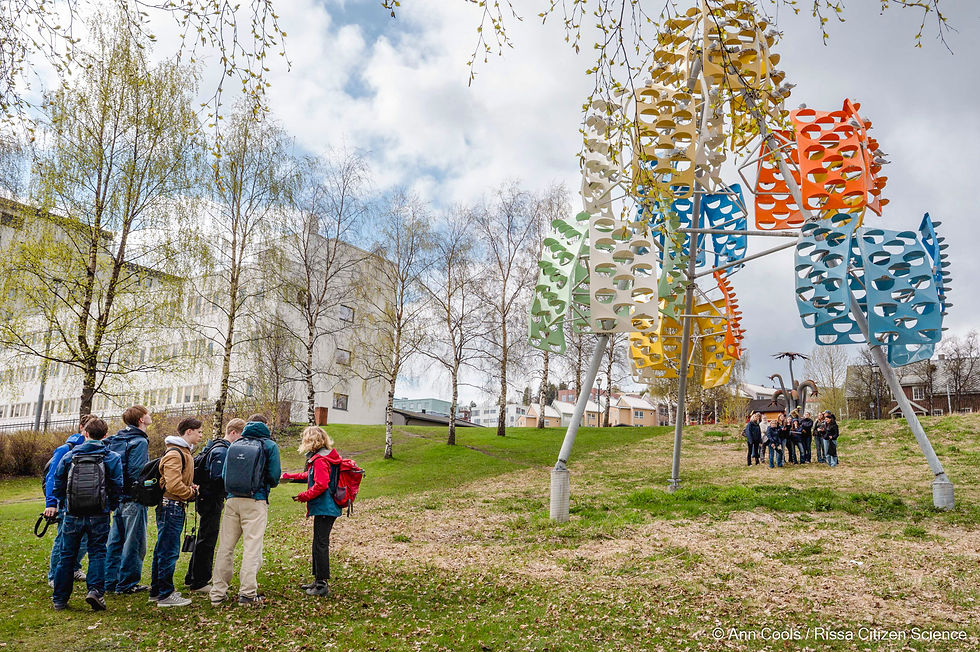
Kittiwake survey with pupils from a local school in May 2026.
The level of engagement varies between individuals. Naima and Nina, for example, monitor the same two or three hotels almost every day. Rachel surveys all of the hotels two to three times a week. Others check a hotel whenever they happen to pass by. Every observation counts, and together these individual efforts create a powerful dataset that provides a reliable picture of how the kittiwakes are doing in Tromsø.

Rachel during her monitoring round in Tromsø city center, May 2026.
Tourists also contribute. By taking part in nest monitoring workshops, visitors choose a more engaged and regenerative form of traveling, transforming their time in Tromsø into an opportunity to give back. Their contributions not only support valuable conservation efforts, but also add a deeper sense of purpose and connection to their travel experience.

Travelers using two hours of their time in Tromsø to learn about the endangered kittiwake, and survey their nests.
Of the importance of kittiwake hotels in Tromsø
Kittiwake hotels play a very important role in Tromsø, both as a conservation measure and as a tool for facilitating coexistence. As property owners install deterrents to prevent nesting on their buildings, kittiwake hotels provide alternative nesting sites designed to attract displaced birds to chosen locations. By encouraging kittiwakes to settle on these structures, rather than relocating to neighbouring buildings, the hotels help reduce potential conflicts.

Figure 2: Use of kittiwake hotels in Tromsø between 2023 and 2026. The solid line for 2026 shows the number of apparently occupied nests until 15 June. Note that the number of kittiwake hotels in Tromsø city center has varied throughout the years, and that the two hotels above Strandveien 8 were not part of the monitoring in 2023 and 2024.
In 2026, Tromsø's nine kittiwake hotels provide 1,112 nesting ledges, with the potential to host as many breeding pairs of kittiwakes.

Figure 3: Use of the kittiwake hotels in Tromsø city centre on 15 June 2025 and 15 June 2026. Hotels 10, 11 and 12 were installed in 2026, hence the absence of data in 2025.
Can you tell which hotel is which?
Hotel 3: green hotel in Muséparken
Hotel 4: tripod hotel at Fylkeshuset
Hotel 5: megapod at Muséparken
Hotels 6 and 7: wooden hotels by the harbor
Hotels 8 and 9: scaffholding hotel at Fylkeshuset
Hotels 10: colorful hotel at Strandvegen 8
Hotels 11 and 12: silver hotels at Strandvegen 8
Muséparken, Hotel 3: best hotel in town!
The two-year permit allowing Hotel 3 to stand in Muséparken expired before the 2026 breeding season. Luckily for the kittiwakes, a one-year extension was granted by Tromsø municipality. Although this is a temporary solution, it was a very good news because this year again, Hotel 3 is the most popular kittiwake hotel in Tromsø, with an occupancy rate of over 80%, and 40 "apparently occupied nests" at the start of the incubation period. Kåre Grunvald is the artist who designed this hotel.

Hotel 3, by far the most popular hotel in Tromsø, June 2026.
Hopefully, Hotel 3 will get some much-needed maintenance once the breeding season is over and will be able to stay where it is next year. Removing Hotel 3 would be a setback for kittiwake conservation. Kittiwakes are highly faithful to their nesting sites, usually returning to the same nest year after year. Hotel 3 has become an important breeding site in Tromsø, helping an endangered species successfully raise a significant number of chicks each season.
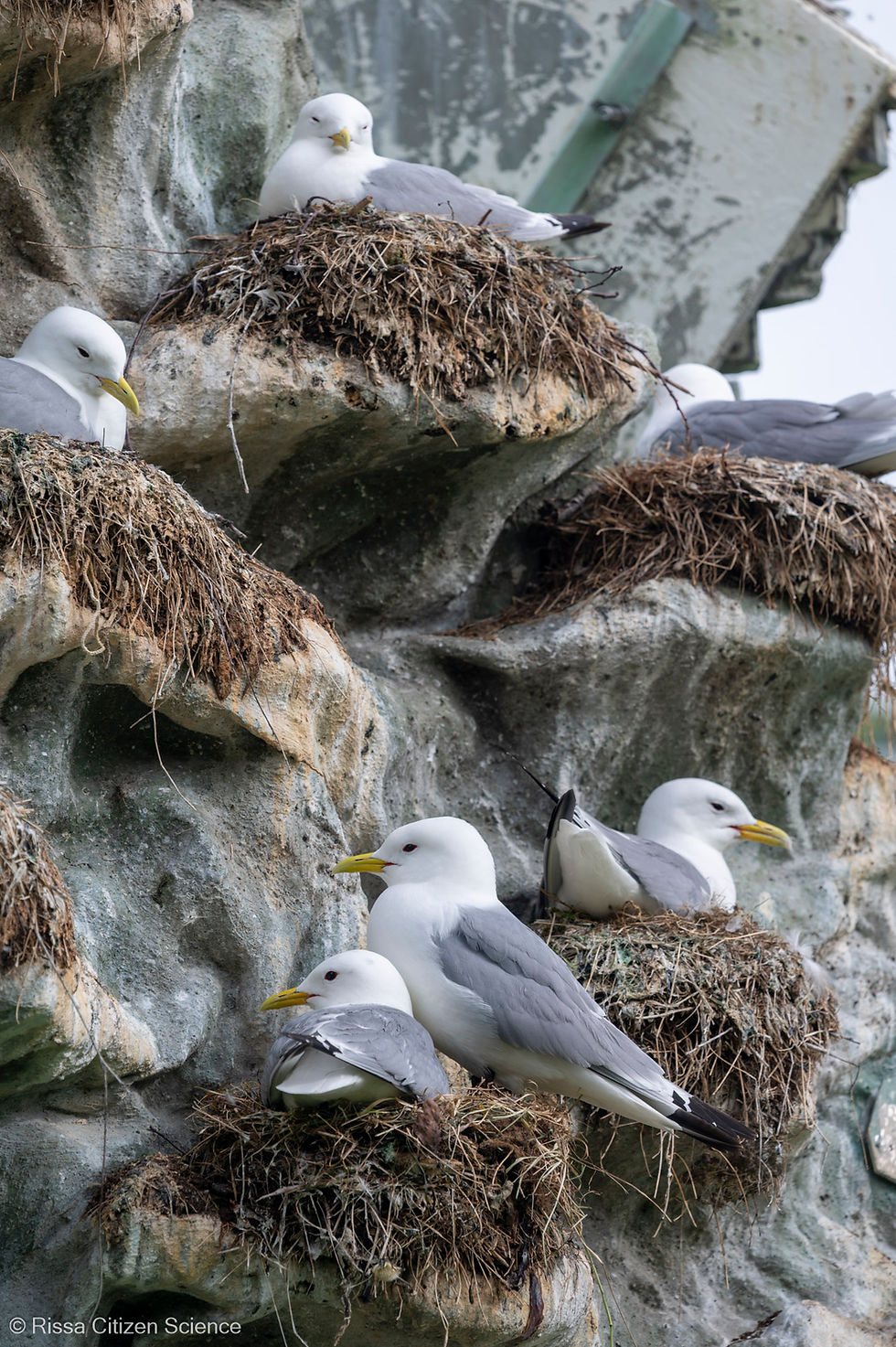
Hotel 3 in June 2026.
Muséparken, Hotel 5: XXL
This is the second breeding season for Hotel 5, and its attractiveness to kittiwakes has increased considerably compared with last year. Between 2025 and 2026, at the same period, the number of "apparently occupied nests" increased from 30 to 51. Considering that Hotel 5 offers 460 nesting ledges across three floors, there is clearly plenty of capacity left, and exciting potential for the years ahead.

The land-facing top floor of Hotel 5 in June 2026.
The third floor of Hotel 5 appears to be the most attractive to kittiwakes, likely because it rises slightly above the surrounding treetops. During the breeding season, kittiwakes frequently leave and return to their nests, and having a clear flight path to the sea seems to be an important factor in nest-site selection. Kittiwakes may also show a preference for nesting sites that face the ocean, a pattern that appears to be reflected once again in the occupancy of the top floor of Hotel 5.
While the highest ledges are occupied first, some kittiwakes have also started using the lower levels of Hotel 5. Here too, a pattern seems to emerge: the birds appear to prefer ledges that face away from the nearby trees, suggesting that clear flight access is an important factor in nest-site selection.

A kittiwake chose the first floor of Hotel 5 to build a nest, June 2026.
Mack Øst, hotels 6 and 7: much better than last year!
In 2025, Hotels 6 and 7 were installed to compensate for the loss of approximately 150 kittiwake nests following the demolition of the Mack building. During their first breeding season, the hotels failed to produce any chicks, partly due to inadequate management measures reported in this article. This season, however, the early installation of protective fencing helped reduce disturbance from pedestrians.
Kittiwakes have since established nests primarily on the seaward side of both wooden structures, while the land-facing side has seen little use so far.

Kittiwakes on Hotel 6 in June 2026.
Although the seaward side of Hotels 6 and 7 currently appears quite busy, many of the birds using the ledges are non-breeders. This is why the numbers shown in Figure 4 are still relatively low, as the figure only counts “apparently occupied nests.” As the season progresses, it is therefore likely that both occupancy rates and nest numbers will decline as it happened in 2025 (Figure 4).

Figure 4: Number of "apparently occupied nests" (AON) at the kittiwake hotels in 2025, on 15 June (incubation period) and 31 July (fledging period).
For these hotels to reach their full potential as breeding sites, continuity will be important. Providing stable, long-term nesting opportunities may encourage today's non-breeding birds to return in future years and eventually establish nests of their own. Conversely, relocating these hotels could disrupt this process and potentially reduce their long-term effectiveness.

The seaside of Hotels 6 and 7 in Tromsø city center, May 2026.
Fylkehuset, hotel 4: starting from scratch
Hotel 4 was moved on 15 March over several hundred meters from Muséparken to Fylkeshuset. This relocation caused the number of "apparently occupied nests" to drop from 22 in 2025 to 7 in 2026 at the same period.

Volunteers moving Hotel 4 from Muséparken to Fylkeshuset on 15 March 2026.
Here again, continuity will be important, and more kittiwakes will probably adopt Hotel 4 if it remains in its current location over the following years. Hotel 4 stands between hotels 8 and 9 that have grown more attractive to kittiwakes over the last two years, and in the future, it is likely that Hotel 4 will benefit from its proximity to these two hotels.

A Kittiwalker is counting adults and nests on Hotel 4, June 2026.
Fylkehuset, hotels 8 and 9: much better than last year!
Hotels 8 and 9 were established in 2024 to offer alternative breeding sites to kittiwakes displaced from the Fylkeshuset building. Two years later, the results are encouraging. Most kittiwake pairs have now been successfully deterred from the building, while the use of Hotels 8 and 9 has increased. In short: it's working! If these hotels remain in place, their attractiveness is likely to continue increasing over time.

Hotel 8, June 2026.
Hotels 10, 11 and 12 at Strandveien 8: promising!
Following the unfortunate events of 2025, conditions have improved considerably this year for the kittiwakes nesting around Strandveien 8. Three new kittiwake hotels were installed earlier this season, and all have already attracted birds. While Hotel 10 is off to a relatively slow start, Hotels 11 and 12 are performing relatively well considering it is their first breeding season.

One of the four plates of Hotel 10, mounted on Strandveien 8, June 2026 (photo Marion Bocquet)
Hotels 10, 11 and 12 are the outcome of a fruitful collaboration between architect Kjeld Nash, artist Lawrence Malstaf who designed and built the structures, Tromsø kommune and Strandveien 8's property owner.
The demolition of the Strandveien 8 building is expected to take place in the future. When that happens, it is hoped that these hotels will remain in the surrounding area and continue to provide attractive nesting opportunities for kittiwakes. Maintaining the structures close to where they are now would help support the long-term success of the relocation effort, and reduce conflict by limiting the likelihood of birds settling on nearby buildings where they are not welcome.

Hotel 11, June 2026 (photo Marion Bocquet)
Last but not least!
There are now nine kittiwake hotels in Tromsø city centre. Experience shows that continuity is key: hotels tend to become more attractive to kittiwakes when they remain in the same location over time. Kittiwake hotels are proving to be an effective tool for facilitating coexistence with this endangered seabird in an urban environment. By providing dedicated nesting sites, kittiwake hotels help keep breeding birds away from buildings where they are not welcome, benefiting both the birds and the building owners.
This article reports about the kittiwake hotels. We will report on the nests in the city in a next article.
Adopt a kittiwake, join the Kittiwalkers!: two ways to support and engage for the protection of the kittiwakes in Tromsø. Follow the links!

Kittiwakes on Hotel 3 in June 2026.
About the data:
This project relies on the much appreciated efforts of trained volunteers. Citizen science inherently comes with uncertainties. We account for these in our analysis, so we can assess the current situation of kittiwakes in Tromsø and compare it to previous years to the best of our knowledge.
As the frequency and quality of observations can vary across time and locations, we group all observations into two-week periods instead of looking at every single observation individually. For each period, we calculate the 75th percentile, a statistical method that filters out extreme (probably incorrect) observations. This way we don’t rely on single observations, while we do focus on the higher end of the reported numbers, which in our experience best reflects the true occupancy.
Aknowledgments:
The Kittiwalkers are the ones surveying kittiwake's nests and sharing their observations.
Roel Melman analyse the Kittiwalkers data, and produced the figures in this article.
Philip Redecker designed and continuously improves the Rissa Citizen Science app, which the Kittiwalkers use to enter their observations.
The Hurtigruten Foundation is supporting our work with the kittiwakes in Tromsø this year.
Focus Nordic has helped us acquire binoculars, which volunteers can borrow.
Marion Bocquet let us use some of her photographs in this article.
To everyone mentioned above, a heartfelt thank you for your support, dedication, and contributions!


Comments