
Sea urchins and kittiwake guano: the fertilizer experiment.

Updated: Jun 17
Kittiwakes bring phosphorus from sea to land through their digestive tract, while urchins are rich in calcium and nitrogen. Can these two species help us boost vegetation growth during the short Arctic summer? Can conservation efforts play a role in strengthening food security? This summer in Tromsø, we will be exploring these questions through an exciting initiative, in collaboration with DYRK and ViNN.

The experimental site in Muséparken, as part of the ViNN project.
The precious poop
Seabird guano is renowned for its fertilizing properties, rich in both phosphorus and nitrogen, and the endangered kittiwake is no exception. Their droppings provide a potent natural boost for plant growth. In Tromsø, the effect is easy to spot: beneath the kittiwake hotels standing in Muséparken, nitrogen-loving plants and grasses flourish, reaching impressive dimensions and creating islands of vibrant greenery that stand out against the neatly trimmed lawns nearby.

Dandelions growing right under kittiwake nests, in Muséparken, Tromsø.
This summer, we are putting this natural fertilizer to the test. Kittiwake guano is being collected and used in two small-scale experiments: one involving wild plants in Muséparken as part of the ViNN project, and another focusing on lettuce at DYRK.

The tarp we deploy under one of the kittiwake hotels in Muséparken to collect guano, June 2026.
Urchins: a byproduct of kelp forests restoration?
Since the 1970s, overfishing in Northern Norway has extirpated many of the natural predators that once regulated green sea urchin populations. As sea urchin numbers increased unchecked, they consumed the kelp forests that provided food and shelter for countless marine species. In many areas, these productive underwater forests have been replaced by barren seafloors dominated by sea urchins.
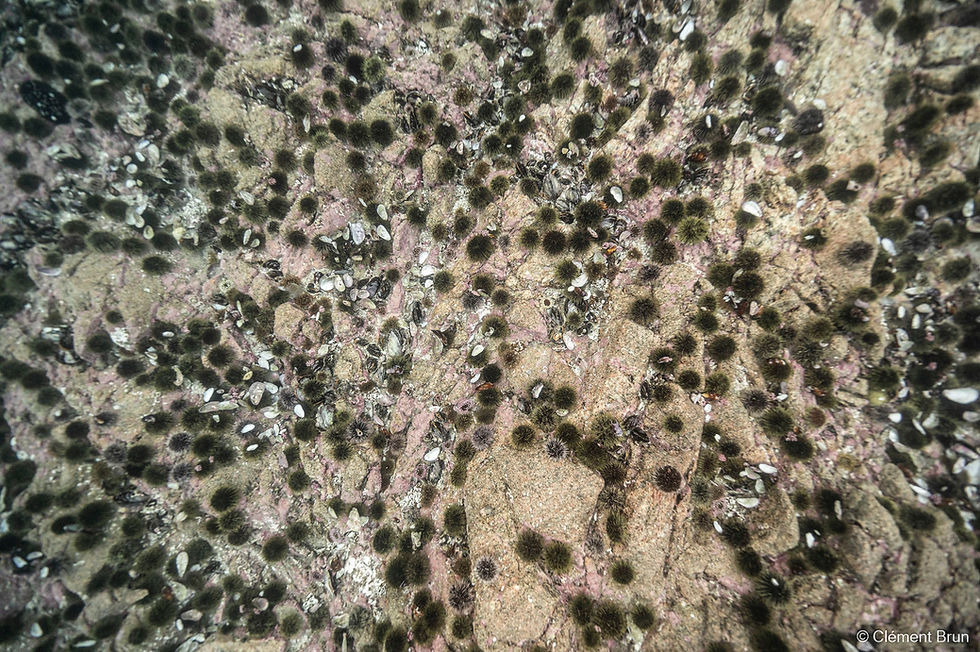
Typical urchin barren near Tromsø.
A lasting solution to kelp forest loss would be to address its underlying causes, particularly overfishing, so that natural predators can once again regulate sea urchin populations and maintain the balance of the ecosystem. But we are not there yet, so in the meantime, volunteers joining Rissa Citizen Science's restoration events are reducing sea urchin densities at two restoration sites, helping create the conditions needed for kelp to return.
Kelpers at the Telegrafbukta kelp restoration site, June 2026.
One of Rissa Citizen Science's kelp restoration sites is located along a jetty called Sørsjetéen, in Tromsø city center, just 300 metres from Muséparken. This summer, some of the urchins collected at Sørsjetéen will make that short journey from sea to soil, where they will be used as fertilizer.

Sea urchins collected from one of Rissa Citizen Science's kelp restoration sites in Tromsø, June 2026.
The ViNN project
Rissa Citizen Science's fertilizer initiative using kittiwake guano and sea urchins nicely merged with the ViNN (Vegetation in Northern Norway) project.
The ViNN project is an interdisciplinary initiative exploring how native vegetation can be used more systematically and sustainably in urban environments. The ViNN project brings together 15 partners, ranging from municipalities and landscape architects to researchers, plant producers, designers, and contractors.

Mari and Yulia planting wild perennials under a kittiwake hotel in Muséparken, June 2026.
As climate change reshapes ecosystems, and the widespread use of standardized, often non-native plants continues, natural diversity is declining and the spread of invasive species is increasing. At the same time, there is still limited knowledge and practical experience on how local vegetation from Northern Norway can be integrated into urban spaces. ViNN aims to bridge this gap by developing sustainable, site-specific solutions that promote biodiversity and strengthen climate adaptation.

Project leader Mari Bergset, a landscape architect at Lo:Le Landskap, and researcher at UiT/The Arctic University of Noway is removing a dominant plant from under a kittiwake hotel in Muséparken.
Testing kittiwake guano and sea urchins in Muséparken
Beata Willman, a landscape architect involved in the ViNN project, designed the site where we are now testing the effects of locally-sourced fertilizers on 12 species of wild plants. Her challenge: creating a space where nature is allowed to flourish freely while still conveying a sense of care and order.

The site in Muséparken where wild plants are allowed to thrive.
The Muséparken site is divided in four quarters enriched with:
1- Sea urchins,
2- Sea urchins and kittiwake guano,
3- Kittiwake guano,
4- Nothing (control).
The wild perenials were added on 10 and 11 June. We will now be following the growth with photos every week.
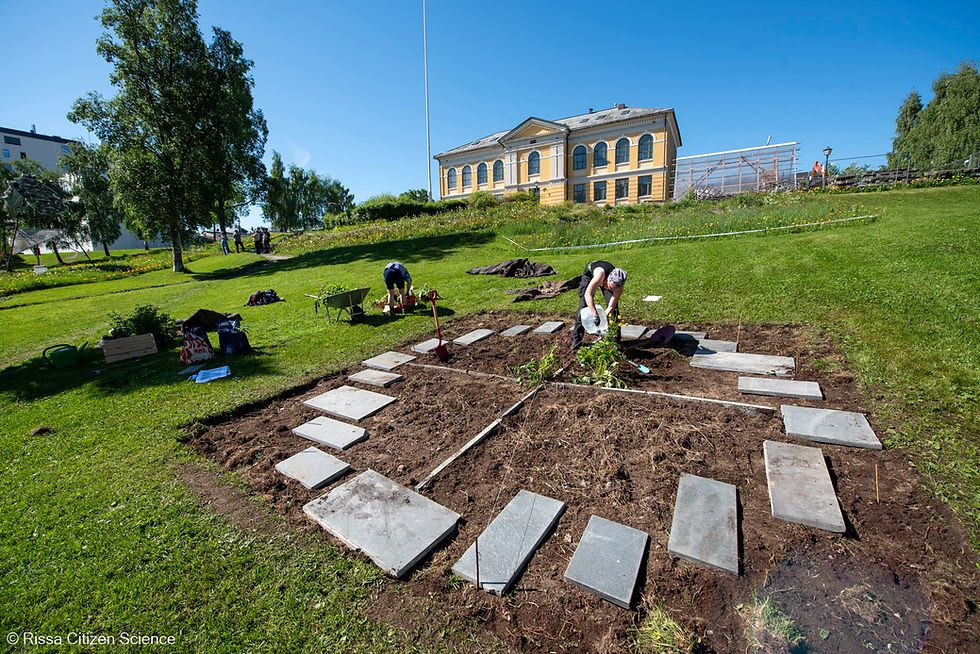
The site in Muséparken, just before planting the wild perennials.
DYRK, the community garden
DYRK Tromsø was established in the spring of 2015 as Tromsø city center's urban vegetable garden. During the summer, people cultivate a wide variety of vegetables, herbs and berries in 50 boxes. DYRK is an inclusive project that welcomes everyone. It is a place for growing food, but also for relaxing, playing and learning.
DYRK Tromsø welcomed our initiative, and they are letting us use three boxes where we are now testing sea urchins and kittiwake guano on lettuce.

Rachel Thume, who is doing her internship at Rissa Citizen Science is leading the fertilizer project.
At both sites, we faced a practical question: how much guano and how many sea urchins should we use? Guano, in particular, is extremely rich in phosphorus and nitrogen, and we are now crossing our fingers that we weren't a bit too enthusiastic with the dosage!
If the lettuce in the control box ends up looking healthier than the lettuce receiving the fertilizers, we'll know that a lighter touch is needed next time. After all, this project is very much part of a learning process, and every outcome will help us better understand how urchins and guano can be used most effectively.
The DYRK boxes with the young lettuces and urchins (left), kittiwake guano (middle) and no fertilizer (right) on 11 June.
Would you like to participate?
If this project inspires you, you are welcome to join the team! Contact us, and Rachel will get back to you. You can help water the lettuce, remove the competing plants, take the weekly photos, document the growth, and tell the story with us!

Rachel planting lettuce in the control box of DYRK Tromsø on 31 May.
Rissa Citizen Science extends its sincere thanks to Mari Bergset and Eva Breitschopf for embracing our initiative and providing a space to explore a more positive narrative around kittiwakes and sea urchins in Tromsø.
From the very beginning, Berit Steenstrup, one of the two initiators of DYRK Tromsø, welcomed our project with enthusiasm. We are thankful not only for her support, but also for the opportunity to connect with the friendly community of people who keep this urban garden lush and vibrant.
Our sincere thanks also go to Tromsø Municipality for supporting this fertilizer initiative and, more generally, the ViNN project. A special thank you to Robert Lund Mentzoni for his support and printing the information sign in Muséparken.
Abirami Ramu Ganesan from NIBIO Bodø shared some advice with us on fertilizing lettuce with sea urchins, based on her research in the Ocean Green project (read the article «From sea to lettuce to better nutrition for Norwegians: early tests show biomass boost with urchin derivatives»)
Finally, many thanks to Lawrence Malstaf for putting us in touch with Mari Bergset while we were still searching for a location for this initiative.


Comments