
Ocean and art week in Øksfjord's kelp forest: creating blue communities
Øksfjord’s Kelp Forest – Creating Blue Communities was an eight‑month project aimed at spreading knowledge and raising awareness about kelp forests through citizen science and art. After the project concluded in May, our project group has had time to reflect, and in this article we highlight some of the most memorable moments from the spring.

Giant kelp at the jetty in Øksfjord (foto: Ismaele Tortella)
Hva er en tare, hva er en tareskog og hvorfor er den viktig?
Kelp is a brown alga that lives for several years. Like land plants, kelp needs sunlight for photosynthesis, where it produces sugar and oxygen from carbon dioxide and nutrients. It grows in shallow coastal areas where it can attach to hard substrate and have access to sunlight. The kelp species found around the Lopphavet area include sugar kelp, winged kelp, dabberlocks and tangle kelp. Tangle kelp is the largest species and can grow up to 5 meters tall and live for 25 years.
When kelp grows densely side by side, it forms a kelp forest. The kelp forest is home to a wide range of marine animals. Small fish find food and shelter among the large kelp blades swaying in the currents, while small bristle worms hide in the holdfast (the structure the kelp uses to cling to the seabed). The thick kelp stipe provides a surface for small algae such as red algae and sea lettuce, as well as marine animals like sponges, bryozoans and sea squirts. Between the kelp plants, more than 250 mobile species thrive, including starfish, hermit crabs, lumpsuckers, crabs and coastal cod. In short, it is a true biodiversity haven!
In addition to providing habitat for marine life, kelp forests offer other important ecosystem services. They filter excess nutrients from the water, absorb carbon from the atmosphere, produce oxygen, and are used in the food industries. Strong kelp forests also form the first line of defense along the coast against large waves from the west, helping to prevent coastal erosion.
Tidepool days with the Schools in Øksfjord and Bergsfjord
The Ocean and Art Week in May began with wonderful outdoor days in the intertidal zone together with Høgtun School in Øksfjord and the school in Bergsfjord. Artist and educator Emma Gunnarsson from Arctic Lux, and Lopphavet Marine Protected Area manager Anita Holmgren, joined from the project group. The goal was to create an engaging program where students could explore the kelp forest with multiple senses and spark curiosity about marine life.
The students got to see, feel, smell and taste different types of seaweed and kelp. Emma had prepared a variety of samples, including sugar kelp chips with sesame seeds, candied sugar kelp, bladderwrack popcorn and fried dulse (also called vegetarian bacon). Each class pressed algae in a plant press to study different species and create their own herbarium. We examined animals from the kelp forest and searched for crabs, rock gunnel, amphipods and small starfish among the shoreline rocks.
For lunch, we served foil‑baked cod from Øksfjord Fiskeindustri. Smaller groups also made potatoes with seaweed and sugar kelp pancakes.
This was a success with students of all ages.
The students were also encouraged to collect treasures they found on the shore to use in their own artwork during the classroom art workshop. There was also time for a campfire and free play.
The students got to taste kelp and use a plant press to make a herbarium of different algae species (foto: Emma Gunnarsson & Anita Holmgren)
Art Workshop in the Classroom with Artist Emma Gunnarsson
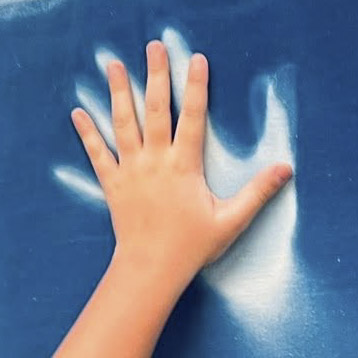
Emma works with cyanotype in her own art. Cyanotype is an analog photographic technique that does not use a camera. Objects are placed on a photosensitive material—fabric or watercolor paper treated with two different iron salts. When exposed to UV light (from the sun or lamps), a chemical reaction occurs, turning the exposed areas blue. Where objects block the light, the surface remains white. This creates blue‑and‑white images.

Artwork of a wolffish made by 1.-4. grade students in Øksfjord (foto: Emma Gunnarsson)
In Øksfjord, this was the second time the students worked with cyanotype, so it was time to experiment with toning the finished images. Younger students toned their images with green tea and lemon, while older students bleached their images with lye to create yellow tones, then dyed them pink or red using the natural dye in the plant madder.
The students got to proceed with the cyanotype technique and toned their image with lye and plant dye (foto: Emma Gunnarsson)
Many beautiful artworks were created in both Bergsfjord and Øksfjord. All students made at least one personal piece inspired by the kelp forest, and large group artworks were made on fabric inspired by the wolffish.
Community Meeting at Loppakroa, Friday May 8
One of the most rewarding aspects of this project has been the local engagement and contribution from businesses and individuals in Loppa municipality. The ocean is important to people here, and it shows. Throughout the project, we have been met with curiosity and interest, and we have learned a great deal about the kelp forests around Lopphavet through local stories.
A total of 75 people attended the community meeting at Loppakroa. We enjoyed delicious pizza made by Maria and Kim while Delphin Ruché from Rissa Citizen Science presented the results from the kelp forest restoration on the jetty in Øksfjorden. The transformation from a barren sea urchin desert to a lush kelp forest was documented by underwater photographer Ismaele Tortella, who shared his images.

75 people came to the gathering in Loppakroa with pizza and underwater photos from the restoration of the kelp forest on the jetty in Øksfjord (foto: Stina Beathe Lorentzen Pedersen)
Ocean and Art Day, Saturday May 9
Saturday, May 9, was a truly delightful day. It began with a family event on the shore in Øksfjord. There was campfire coffee, foil‑baked fish, potatoes with seaweed, sugar kelp pancakes, grilled toast with truffle butter, and tastings of seaweed prepared as pickles, chips and salt by Emma. Children also got to meet marine animals from the kelp forest together with Anita.
After the family event, the local artist Sinbad performed a show at the cafe Støa. Afterwards, visitors could join an open cyanotype workshop with Emma, creating their own blue prints using old negatives, seaweed and marine objects. Many artists of all ages attended. Since the weather was good, images were exposed both under UV lamps indoors and in the sunlight outside.
On Saturday, a shore day was organized with sea creatures and tasty bites of seaweed and kelp, and an open art workshop (foto: Emma Gunnarsson & Anita Holmgren)
What Happened to the Kelp Forest, and How Can We Bring It Back?
In the 1960s, a dramatic shift occurred in the coastal ecosystem of Northern Norway, a so‑called regime shift. Lush kelp forests were transformed into areas dominated by sea urchins. This was caused by modernization of the fishing fleet and more efficient harvesting of predatory fish such as cod, haddock, saithe and wolffish. These fish had previously consumed large amounts of sea urchin larvae and adult urchins. When the larvae were no longer eaten, they grew and settled along the coast in huge numbers, with catastrophic consequences for the kelp forest. Sea urchins love to eat kelp, and when there are too many of them, they graze entire forests down to bare rock.
Most areas in Northern Norway that once had kelp forests are still dominated by sea urchins, as they have been for decades. The question is: how do we bring the kelp forest back?
In this project, we restored kelp by removing sea urchins and observed that a small area on the jetty in Øksfjord has once again become a kelp forest. When scaling up kelp restoration, it is important to consider how the ecosystem functions. If we restore kelp by removing sea urchins, or if crabs move in and eat them, it is not guaranteed that we will get the same kelp forest we had 100 years ago. Instead, we may get a kelp forest where crustaceans are the top predators. This creates a different ecosystem. We see signs of this ecosystem transformation in eastern Finnmark, where king crabs dominate, and in the Gulf of Maine in the northeastern United States. Read more here: Kystbarometereet.

A wolffish is eating a sea urchin (foto: Ismaele Tortella)

King crab (foto: Ismaele Tortella)
If we want to restore the kelp forest that once existed along the coast of Finnmark, it is essential to also bring back predatory fish such as wolffish and coastal cod. And if there is one thing we have learned from this project, it is that we can bring back a kelp forest full of life if we give nature the space it needs to grow and restore.
We would like to thank the main sponsors of this project: Sparebankstiftelsen Sparebank1 Nord-Norge and Norges Råfisklag. We also want to thank the local businesses Støa, Øksfjord Fiskeindustri and Loppakroa for sponsoring the project. A big thank‑you as well to Øksfjord municipality and Høgtun school for their support, especially the teachers we worked with during the school days.


Comments