
A photo exhibit at Sørsjetéen

Updated: Jan 20
Since January 9th, an outdoor exhibition has been celebrating the work of the Kelpers, these dedicated volunteers restoring kelp forests in Tromsø. Through photographs by Clément Brun, Liga Sirava, and Ann Cools, the exhibition documents the remarkable shift from urchin desert to flourishing kelp forest in the heart of the city.

One of the photos of the exhibit showing a volunteer restoring the kelp forest along the jetty.
Lush to barren
No one knows exactly how much of Norway’s kelp forests have disappeared since the 1970s. Estimates suggest around 80 percent, or possibly even more. Sea urchins are often blamed for this loss. But the green sea urchin is a native species in Norway and has always been living alongside kelp. So what changed?
The big shift came in the 1970s, when fishing pressure increased and many of the sea urchin’s natural predators were removed from the ocean. With fewer predators, sea urchin populations exploded and began overgrazing the seabed. In Northern Norway, rocky coastlines that once supported rich kelp forests have turned into "urchin barrens", where only a few species now dominate.
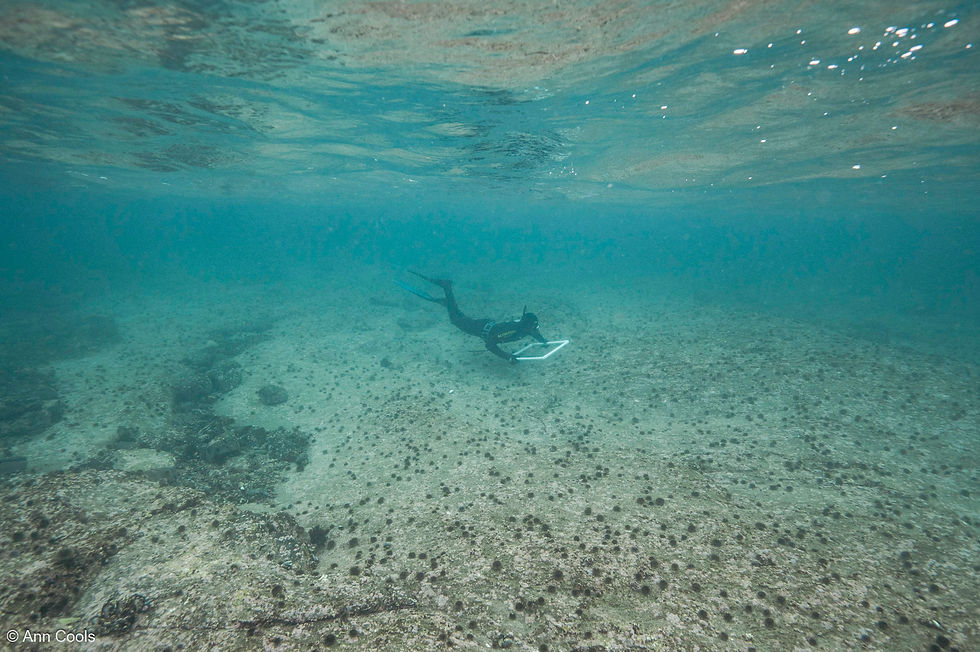
Urchin barren at the Telegrafbutka restoration site (photo Ann Cools).
Barren to lush again
In October 2023, volunteers began working to bring kelp back to Sørsjetéen, a 200-meter-long jetty extending from Tromsø city center into the sound. The approach was simple: reduce the number of sea urchins, manually, one by one. Once sunlight returned in spring (Tromsø lies 350 kilometers north of the Arctic Circle and the sun doesn't set in winter) kelp and other seaweeds began to grow back on their own. Then, within just a few weeks, a dense kelp forest had returned.
Video showing the spectcular shift from urchin barren to kelp forest at Sørsjetéen.
For educational purposes, the Kelpers removed sea urchins only on the southern side of the jetty, leaving the northern side untouched. Their goal was to make the contrast between an urchin barren and a healthy kelp forest visible to everyone walking along the jetty, and that is exactly what happened. To date, the Kelpers have removed more than 56,000 sea urchins during restoration events organized by Rissa Citizen Science.
The photographers
The photos on display were taken along Sørsjetéen by three experienced underwater photographers. Their contribution has been essential to our work: while our primary goal is to restore kelp forests, our outreach efforts depend on making this transformation visible. If we cannot show the change taking place, we fall short of our mission to raise awareness.
For this, we would like to express our our deep gratitude to Clément Brun, Liga Sirava and Ann Cools, three extremely talented photographers. Explore their work online and you’ll understand why we’re so grateful to have their support!
Clément Brun, Ann Cools and Liga Sirava.
The Ocean Green project
Rissa Citizen Science's effort to restore kelp forests with volunteers is part of the Ocean Green project, led by Ava Ocean and funded by the Research Council of Norway and Innovasjon Norge. The aim of the project is to scale up the restoration of kelp forests, and boost biodiversity by developing non-invasive urchin harvesting tools and by finding new, commercially-viable uses for sea urchins. All the project's partners contributed to financed the exhibit. Many thanks to Ava Ocean, NIBIO, NIVA, Akvaplan-niva, Across Nature and Hoseth BioCare for their contribution!

The exhibit along the jetty just after the inauguration in January.
They facilitated the exhibit
CEWE generously provided a discount on the photo printing, making it possible to include eleven large-format photographs. The print quality is outstanding, and the images are printed directly on Dibond aluminum, with UV-ink, ensuring they can withstand sea spray and Tromsø’s harsh weather conditions.
This project would not have been possible without the support from Tromsø kommune and Tromsø Havn, which allowed the photos to be displayed along the jetty.
Tromsø-based artist Lawrence Malstaf built the aluminum frames, with ingenuity and precision. The result looks fantastic, thanks to him, and also to another artist—Sam Thys—who helped mount the frames.

The exhibition on January 15th, the day the sun rises for the first time in 2026.
More photos will come
Right now, six frames are on display. Five more will be added in the near future, and we’ll share the update as soon as they’re up. Stay tuned!
In the meantime, feel free to join the next kelp forest restoration event and be part of the adventure! All events are free, and you can help from land or in the water. Volunteers are treated to waffles and hot drinks. You’re welcome to drop by to see how things go and meet the Kelpers before deciding if you’d like to join in the sea.

The Kelpers on the 27th of September 2025 at Telegrafbukta, Rissa's second kelp restoration site.


Comments